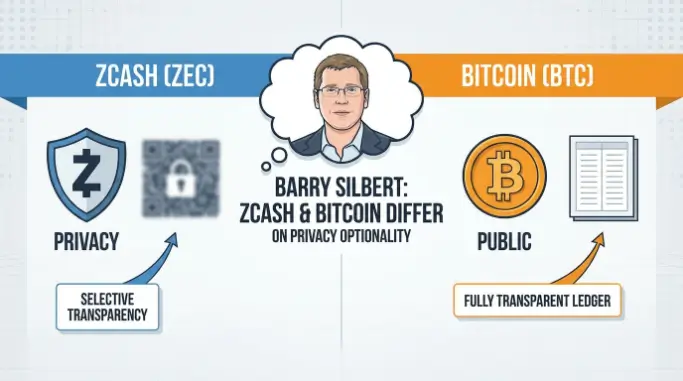
The Barry Silbert Zcash Bitcoin comparison has become an interesting topic in the cryptocurrency world because it brings together three important ideas: Bitcoin’s position as the best-known digital asset, Zcash’s focus on financial privacy, and Barry Silbert’s long-standing involvement in both parts of the crypto market.
Barry Silbert is the founder of Digital Currency Group (DCG), a major company in the cryptocurrency industry. He has supported Bitcoin for many years, but he has also been a notable supporter of Zcash. That makes his views particularly interesting when investors compare the two cryptocurrencies.
The comparison is not really about saying that Bitcoin is good and Zcash is bad, or that Zcash will definitely replace Bitcoin. The two projects were built with different priorities. Bitcoin focuses heavily on decentralized money, scarcity, security, and transparency. Zcash takes many of those ideas and adds advanced privacy technology that allows users to make transactions with information hidden when they choose to use shielded addresses.
In 2026, the discussion has become even more relevant. Silbert has publicly argued that privacy could become an important new theme in cryptocurrency and has suggested that a portion of Bitcoin-related capital could move toward privacy-focused assets such as Zcash.
Who Is Barry Silbert?
Barry Silbert is one of the better-known early investors in the cryptocurrency industry. Before building Digital Currency Group, he founded SecondMarket, a platform that helped investors trade private company securities.
Silbert became an early Bitcoin investor when the cryptocurrency was still relatively small. According to reporting by The Information, in 2013 he persuaded the board of SecondMarket to allow the company to use about $3 million to purchase Bitcoin. That investment later became an important part of the story behind DCG.
His involvement did not stop with Bitcoin. Digital Currency Group also invested in several other cryptocurrency projects, including Zcash. Silbert has explained that DCG’s direct cryptocurrency investments historically included Bitcoin, Ethereum Classic, Zcash, Decentraland, and Horizon.
This history matters because it shows that Silbert does not view cryptocurrency as a one-asset market. He has backed Bitcoin while also looking for projects that solve different problems.
Why Is Barry Silbert Interested in Zcash?
The biggest reason is privacy.
Bitcoin transactions are recorded on a public blockchain. Anyone can inspect the blockchain and see transaction information such as addresses and amounts. Although a Bitcoin address does not automatically reveal a person’s real-world identity, blockchain analysis can sometimes connect addresses and transactions to individuals or organizations.
This is very different from the original popular idea of Bitcoin as completely anonymous money.
Zcash was designed to approach digital money differently. Its technology allows users to make shielded transactions using zero-knowledge proofs. In simple terms, the system can verify that a transaction is valid without publicly revealing all of the transaction’s sensitive details.
This distinction is at the center of the Barry Silbert Zcash Bitcoin comparison.
Silbert has argued that Bitcoin’s public nature makes it difficult for Bitcoin itself to become truly private. In 2026, he said he expected some Bitcoin capital to move toward privacy-focused cryptocurrencies. He specifically mentioned a possible 5% to 10% shift over the coming years.
That is an opinion and market thesis, not a guaranteed prediction.
Bitcoin and Zcash Have Similar Foundations
Although Bitcoin and Zcash are very different in some areas, they also share important characteristics.
Both are decentralized cryptocurrency networks. Neither depends on a traditional bank to maintain its blockchain. Both use proof-of-work mining and both have a maximum supply of 21 million coins.
Bitcoin’s maximum supply of 21 million BTC is one of the main reasons it is often described as scarce digital money. Bitcoin’s own documentation confirms that only 21 million bitcoins will ever be created.
Zcash also has a 21 million maximum supply of ZEC.
That similarity makes the comparison particularly interesting. Investors are not comparing two completely unrelated assets. They are comparing two networks that share some basic monetary ideas but take different approaches to privacy and use.
Bitcoin’s Biggest Strength: Network Effect
Bitcoin has a huge advantage that Zcash cannot easily copy: its network effect.
Bitcoin has been around since 2009 and has become the most recognized cryptocurrency in the world. It is supported by a large ecosystem of exchanges, wallets, miners, developers, financial institutions, payment companies, and investment products.
That size creates a powerful feedback loop.
More users attract more businesses. More businesses attract more investors. More investors increase liquidity. Higher liquidity makes it easier for large institutions to enter and exit positions.
Bitcoin has also developed a strong institutional investment story.
The introduction and growth of regulated investment products has helped make Bitcoin easier for traditional investors to access. This is one reason Bitcoin is generally viewed as a more established cryptocurrency than Zcash.
Zcash’s Biggest Strength: Financial Privacy
Zcash has a different selling point.
Its strongest argument is that financial transactions do not always need to be completely visible to everyone.
Imagine paying someone with a cryptocurrency. You may want the transaction to be verified, but you may not want strangers to see your balance or follow your entire transaction history.
Zcash’s shielded transaction technology was designed around this idea.
Privacy can be useful for individuals, companies, charities, and other organizations. Financial information can reveal much more than people realize, including business relationships, spending habits, income patterns, and payment activity.
That does not mean everyone needs a privacy coin. But it explains why privacy remains an important topic in cryptocurrency.
Barry Silbert Zcash Bitcoin Comparison: Privacy
Privacy is probably the clearest difference between the two.
Bitcoin’s blockchain is transparent. Transactions can be inspected publicly, although identifying the person behind an address is not always straightforward.
Zcash offers both transparent and shielded transaction options. This means users can choose privacy features depending on their needs.
That optional approach is important because it gives Zcash a different identity from Bitcoin.
Bitcoin is primarily associated with transparency, scarcity, decentralization, and long-term monetary value.
Zcash is more strongly associated with privacy-preserving digital cash.
Supply: Bitcoin vs. Zcash
Both Bitcoin and Zcash have a maximum supply of 21 million coins, but supply alone does not determine the value of a cryptocurrency.
Bitcoin’s scarcity has become one of its strongest narratives. Its issuance schedule is programmed, and the mining reward is periodically reduced through halvings. The most recent Bitcoin halving occurred in April 2024, reducing the block reward to 3.125 BTC.
Zcash also has a capped supply, but market perception is different.
Bitcoin has a much larger user base, deeper liquidity, and stronger institutional recognition. Therefore, having the same maximum supply does not mean BTC and ZEC should have similar market values.
Scarcity is only one part of the equation. Demand, adoption, security, liquidity, technology, regulation, and investor confidence also matter.
Institutional Interest in Zcash
One of the most interesting developments in the Zcash story has been the growth of institutional access.
Grayscale launched the Zcash Trust in 2017, providing investors with a way to gain exposure to ZEC through an investment product rather than holding the cryptocurrency directly.
That product later went through an important transformation. In August 2026, an SEC filing stated that the Grayscale Zcash Trust had changed its name to The Zcash ETF.
Another SEC filing dated September 8, 2026, reported that DCG acquired approximately $100 million worth of shares in the Zcash ETF through an authorized participant, using 85,705.32563297 ZEC in the transaction.
This is a significant development in the Barry Silbert Zcash Bitcoin comparison because it demonstrates that Silbert’s interest in Zcash is not simply a social-media discussion. DCG has taken a substantial position through an investment vehicle.
Is Zcash the Next Bitcoin?
This is where investors need to be careful.
Zcash does not need to become the next Bitcoin to succeed.
Bitcoin has a unique position in the cryptocurrency market because of its age, liquidity, recognition, mining network, institutional adoption, and established reputation.
Zcash has a much narrower focus.
Its opportunity is based largely on whether financial privacy becomes more important in the years ahead.
If privacy becomes a major requirement for digital finance, Zcash could benefit. If regulators, exchanges, institutions, and users continue favoring transparent assets, Bitcoin may retain its dominant position.
The two outcomes are not necessarily mutually exclusive.
Bitcoin could remain the primary digital store of value while Zcash becomes a specialized privacy-focused asset.
Why Silbert Thinks Privacy Could Become More Important
Silbert’s argument is based partly on the changing nature of Bitcoin.
When Bitcoin was young, many people viewed it as anonymous digital cash. Today, blockchain analytics companies can analyze transaction activity at a much deeper level.
This means Bitcoin provides pseudonymity rather than complete financial privacy.
Silbert believes that distinction could eventually encourage some users and capital to move toward privacy-focused networks. In February 2026, he suggested that 5% to 10% of Bitcoin capital could find its way into privacy-focused cryptocurrencies over the next few years.
Whether that prediction comes true remains uncertain.
But the argument itself is important because it highlights a potential market that Bitcoin does not directly address.
Regulation Is a Major Factor
Privacy coins face an important challenge: regulation.
Governments and financial institutions are increasingly interested in cryptocurrency transaction monitoring. Privacy technology can make compliance more complicated because it can reduce the amount of information that is publicly available.
This does not automatically mean privacy coins will fail.
Privacy is a legitimate financial need, and there are many legal reasons for individuals and businesses to want confidential transactions. However, regulatory treatment can have a major impact on adoption.
Bitcoin generally has an advantage here because its transparent blockchain makes transaction monitoring easier.
Zcash, on the other hand, must balance privacy technology with broader acceptance by exchanges, financial institutions, and regulators.
Bitcoin vs. Zcash for Investors
An investor comparing BTC and ZEC should first understand that they represent different investment ideas.
Bitcoin is generally viewed as the more established cryptocurrency. Its investment case is based around scarcity, network security, institutional adoption, liquidity, and its role as a potential long-term digital store of value.
Zcash represents a more specialized thesis.
Someone buying ZEC may be betting on the growth of privacy-focused digital money, increased demand for shielded transactions, stronger institutional interest, or a broader shift toward financial privacy.
That can create greater upside potential, but it can also create greater uncertainty.
The smaller market size of Zcash means its price can be more volatile than Bitcoin. Investors should not confuse a potentially larger percentage return with lower risk.
A Simple Comparison
The easiest way to understand the difference is to think about what each network is trying to achieve.
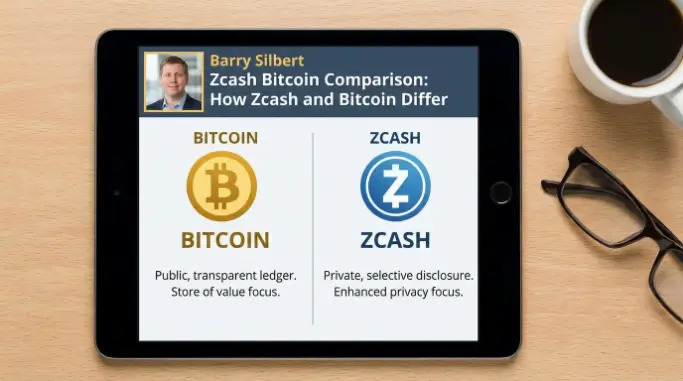
Bitcoin is primarily designed around decentralized money with a transparent public ledger. Its strongest characteristics are scarcity, security, decentralization, liquidity, and a powerful network effect.
Zcash takes the concept of decentralized digital money and adds optional privacy. Its strongest characteristics are shielded transactions, financial privacy, and zero-knowledge technology.
Bitcoin has the larger ecosystem.
Zcash has the more specialized privacy proposition.
Bitcoin is generally easier for institutions to understand.
Zcash offers a feature that could become increasingly valuable if financial privacy becomes a larger concern.
Could Bitcoin Capital Move Into Zcash?
This is the central question behind the Barry Silbert Zcash Bitcoin comparison.
Silbert believes some capital currently associated with Bitcoin could move toward privacy-focused cryptocurrencies. His 5% to 10% estimate has attracted attention because even a relatively small shift from Bitcoin into a much smaller market could have a large effect on Zcash’s market.
However, investors should treat this as a scenario rather than a forecast that must happen.
Capital does not automatically move simply because an influential investor makes a prediction. Zcash would still need to demonstrate continued development, useful privacy technology, sufficient liquidity, regulatory resilience, and real-world demand.
The cryptocurrency market is also highly competitive.
Other privacy-focused projects could compete with Zcash for the same users and investment capital.
What Makes This Comparison Interesting in 2026?
The biggest change is that privacy is becoming a more visible investment theme.
For years, Bitcoin dominated institutional cryptocurrency conversations. More recently, investors have begun looking at specialized blockchain technologies that solve particular problems.
At the same time, institutional access to Zcash has improved. The transition of Grayscale’s Zcash investment product into The Zcash ETF and DCG’s reported $100 million acquisition give the privacy narrative more institutional weight.
This does not guarantee that Zcash will outperform Bitcoin.
It simply means that the conversation has become more serious.
Final Thoughts
The Barry Silbert Zcash Bitcoin comparison is ultimately a comparison between two different visions of cryptocurrency.
Bitcoin has established itself as the dominant decentralized digital asset. Its limited supply, security, liquidity, institutional adoption, and enormous network effect give it advantages that are difficult for newer or smaller cryptocurrencies to reproduce.
Zcash takes another path. It focuses on a problem Bitcoin does not solve by default: financial privacy.
Barry Silbert’s long history with Bitcoin makes his support for Zcash particularly interesting. He was an early Bitcoin investor and has continued to describe Bitcoin as an important part of a diversified crypto portfolio. At the same time, his support for Zcash reflects his belief that privacy could become a major opportunity within the next phase of cryptocurrency development.
The most reasonable way to view the two assets is not necessarily as direct competitors. Bitcoin can continue serving as the industry’s dominant store-of-value asset while Zcash develops as a specialized privacy network.
Whether that happens will depend on adoption, technology, regulation, institutional demand, and the future importance of financial privacy.
For anyone following the cryptocurrency market, the relationship between Bitcoin and Zcash is therefore worth watching. It provides a useful example of how the industry can evolve from one dominant digital currency into a broader ecosystem of networks designed for very different financial needs.
This article is for informational purposes only and is not financial advice. Cryptocurrency prices can be highly volatile, and readers should conduct their own research before making investment decisions.