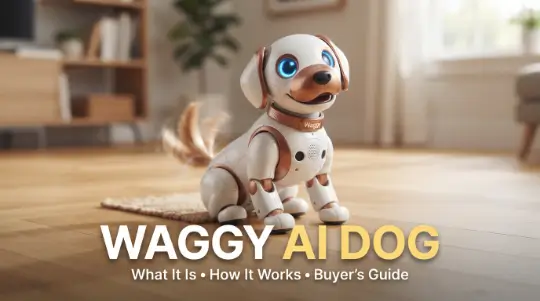
The Waggy AI Dog has attracted attention online with its cute appearance and claims of being an interactive robotic puppy. Videos and advertisements make the product look like a small companion that can move, bark, react to touch, and behave in ways that feel surprisingly close to a real pet.
That sounds appealing, especially for families who love dogs but cannot keep a real one at home. A robotic puppy does not need food, walks, grooming, or veterinary care. It can also be an interesting toy for children who enjoy animals.
But there is another side to the Waggy AI Dog story. Questions have been raised about whether the product delivered to some customers matches the advanced robot shown in advertising. Independent reports and consumer complaints describe a much simpler toy than the one presented in promotional material.
So, what exactly is the Waggy AI Dog, what does it claim to do, and what should you know before spending money on one? This guide looks at the product from those angles in simple terms.
What Is the Waggy AI Dog?

The Waggy AI Dog is marketed as a robotic puppy designed to provide an interactive pet-like experience. Online product pages have described features such as realistic movement, touch response, barking, tail movement, and AI-adaptive behavior. One current Waggy-branded site describes the product as an AI-powered robotic puppy with touch sensors and lifelike movements.
The idea behind the product is easy to understand. Instead of buying or adopting a real dog, a customer can have a small electronic companion that looks and behaves like a puppy while requiring much less care.
This concept is not new. Interactive electronic pets have existed for many years, but modern advertising often uses words such as “AI,” “smart,” and “lifelike” to make these products sound much more advanced.
That is where shoppers need to pay attention.
A product can contain simple motors, speakers, or sensors without actually having sophisticated artificial intelligence. A toy that reacts to a button or touch sensor is not necessarily learning from its owner or developing new behavior.
What Does Waggy AI Dog Claim to Do?
The product’s marketing presents it as much more than an ordinary stuffed animal.
Promotional material describes features such as walking, sitting, running, tail wagging, barking, and responding to interaction. The current Waggy-branded website also claims that the dog can adapt its behavior to a child’s play style.
Those features sound impressive, but consumers should distinguish between advertised capabilities and independently verified performance.
Several independent reports have questioned whether the product actually contains the advanced technology suggested by the advertising. Reviews and investigations have described buyers receiving a simple, low-cost toy rather than the sophisticated robotic companion shown in advertisements.
That difference is important because expectations can change the entire buying decision.
Someone looking for a simple novelty toy might be perfectly happy with a basic electronic puppy. Someone paying for an advanced AI companion will reasonably expect sensors, meaningful interaction, sophisticated movement, and reliable construction.
Does Waggy AI Dog Really Use Artificial Intelligence?
This is one of the biggest questions surrounding the product.
The word “AI” can mean many things in online advertising. In a genuine artificial intelligence system, software may process information, recognize patterns, respond to inputs, or adapt its behavior based on data.
A basic toy can also respond to an input without using anything close to modern AI. For example, a toy may contain a pressure sensor. When someone touches it, the toy activates a prerecorded sound or movement.
That is interactive, but it is not necessarily artificial intelligence.
Independent reports about Waggy have questioned whether the product includes the advanced AI functionality suggested by advertisements. Some reviewers reported no evidence of voice recognition, Wi-Fi connectivity, apps, learning behavior, or sophisticated robotic systems in the product they received.
For shoppers, the safest approach is to look for specific technical information rather than relying only on the word “AI.”
Why Did Waggy AI Dog Become Popular?
The product fits perfectly into a growing interest in smart and interactive toys.
A realistic-looking robotic puppy is naturally attractive to children. Adults may also like the concept because it promises some of the fun of owning a pet without the responsibility that comes with a real animal.
A real dog requires daily care. Owners have to provide food, exercise, training, grooming, veterinary treatment, and attention. A robotic toy obviously cannot replace a living animal, but it can offer a simpler form of play.
Social media also plays an important role in the popularity of products like Waggy AI Dog. Short videos can make a toy look much more impressive than a normal product photograph.
A few seconds of a cute robotic puppy moving around can easily encourage viewers to visit a product page.
The Difference Between a Real Pet and a Robot Dog
It is important not to confuse a robotic toy with an actual pet.
A real dog has emotions, biological needs, individual personality, and the ability to form relationships with people. A robot cannot provide the same experience.
A robotic puppy may be useful as a toy or novelty item, particularly for children who cannot have animals because of allergies, housing rules, or other circumstances.
However, parents should explain the difference to children. A robot does not experience happiness, fear, pain, or affection in the same way a living animal does.
That distinction becomes especially important when advertising uses emotional language that makes a product appear almost identical to a real pet.
What Buyers Have Reported
There are several independent reports describing disappointing experiences with Waggy-related products.
A February 2026 complaint in the Better Business Bureau’s Scam Tracker alleges that a customer paid $29.99 for a Waggy AI Dog but received a much cheaper toy that did not match the advertising. The complaint also alleges difficulties with the return process. This is an individual consumer report, so it should be treated as an allegation rather than proof that every buyer has had the same experience.
Other independent reviews have described similar concerns, including products that were much smaller or simpler than expected and lacked the advanced features shown in promotional material.
These reports do not mean every product sold under every Waggy-related name is necessarily identical. Online sellers can use different websites, suppliers, and versions of similar toys.
That is why checking the exact seller and product listing is important.
Common Warning Signs to Watch For
If you are considering buying an AI robot dog online, there are several things worth checking.
First, look for detailed technical specifications. A genuine advanced robot should have information about its sensors, power source, software, connectivity, dimensions, and operating system.
Second, look for independent reviews. Reviews published only on the seller’s own website are less useful because shoppers cannot easily verify whether those reviews are genuine.
Third, check the return policy carefully. A generous money-back statement sounds reassuring, but the practical details matter. Find out where the product must be returned and who pays return shipping.
Finally, avoid rushing because of artificial-looking countdown timers or claims that only a few products remain. These tactics are commonly used in online shopping and should not replace proper research.
Is Waggy AI Dog a Good Choice for Children?
That depends heavily on what you expect from the product.
If a child simply wants a cute puppy-style toy that makes sounds or moves, a basic interactive toy may provide entertainment.
But if parents are buying it because they believe they are getting a sophisticated AI robot, they should investigate the exact product before ordering.
The age recommendation is also important. Parents should check whether the toy contains small parts, batteries, wires, or other components that could create risks for younger children.
A toy should always be used according to the manufacturer’s safety instructions.
How to Research Waggy AI Dog Before Buying
A few minutes of research can prevent a disappointing purchase.
Start by searching the exact product name together with terms such as “review,” “unboxing,” and “customer experience.” Real photographs and videos from buyers can be particularly useful because they show what actually arrives.
Next, compare the product with similar robotic toys from established manufacturers. If another company provides detailed specifications, demonstrations, warranty information, and customer support, you can make a more informed comparison.
Also check the seller’s contact information and return policy before paying.
Do not rely entirely on a product video. Videos can be edited, staged, or created using material from another product.
What to Do If the Product You Receive Is Different
If you order a Waggy AI Dog or a similar product and it does not match the description, document everything.
Take photographs of the package, shipping label, product, accessories, and any differences between the advertisement and the item you received.
Keep your order confirmation and payment records.
Then contact the seller using the official customer-service information associated with your purchase. If the seller does not resolve the issue, your payment provider may have a dispute process available.
The BBB complaint mentioned earlier illustrates why keeping documentation can matter when there is a disagreement over what was advertised and what was delivered.
Better Questions to Ask Before Buying
Instead of asking only whether the Waggy AI Dog looks cute, ask more practical questions.
Does it actually walk independently? Does it respond to touch? What sensors does it use? Does it connect to an app? Can it recognize speech? Is there rechargeable power or does it use replaceable batteries? What is its actual size? Who manufactures it? Where is the company based? What happens if the product breaks?
Clear answers to these questions are more useful than phrases such as “next-generation AI” or “lifelike technology.”
The more expensive the product, the more important these details become.
Final Thoughts
The Waggy AI Dog is an interesting example of how modern product marketing can combine cute designs, robotics language, and social media advertising.
The idea of a robotic puppy is certainly appealing. A well-designed interactive pet toy can be fun for children and adults, particularly for people who cannot keep a real dog.
However, shoppers should be careful about assuming that every product advertised as an AI robot dog contains advanced artificial intelligence. Independent reports and consumer complaints have raised significant questions about whether some Waggy products match the technology and quality shown in their advertisements.
The smartest approach is to research the exact seller, look for independent customer videos, check technical specifications, read the return policy, and use a payment method that offers appropriate buyer protection.
Most importantly, judge the product by what can be independently verified rather than by an impressive advertisement.
A cute robot puppy can still be a fun toy without being a truly intelligent robotic pet. Understanding that difference before buying can help you avoid disappointment and make a more informed choice.