Artificial intelligence is changing the way organizations work. Companies are using AI to analyze information, automate repetitive tasks, support employees, improve customer service, develop products, and make decisions faster. The technology is moving quickly, and new AI tools appear almost every week.
Yet there is a problem that is often overlooked. Buying an AI system is relatively easy. Making sure that system is used responsibly, securely, fairly, and in line with the organization’s goals is much harder.
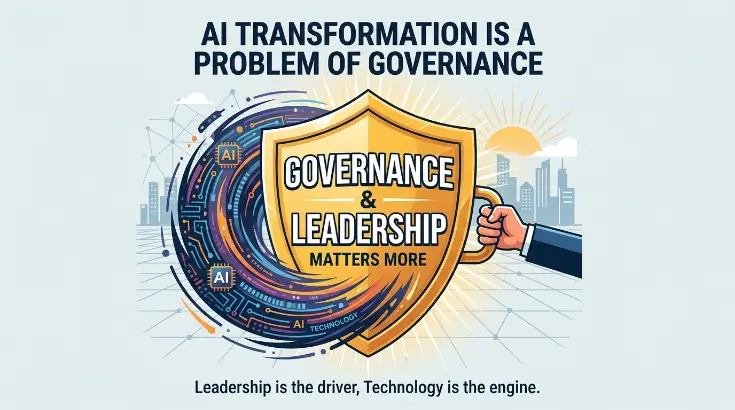
That is why AI transformation is a problem of governance as much as it is a technology problem.
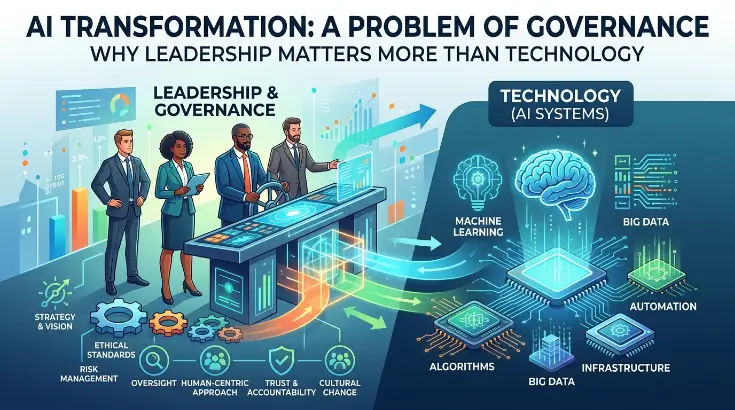
Organizations do not simply need better AI models. They need clear rules, responsible leadership, strong oversight, reliable data practices, and people who understand where AI should and should not be used. Without those things, even an impressive AI system can create financial, legal, security, or reputational problems.
The most successful organizations will therefore treat AI transformation as a leadership and governance challenge rather than simply an IT project.
What Does AI Transformation Really Mean?
AI transformation is broader than adding a chatbot to a website or purchasing an AI-powered software package.
It means changing how an organization performs its work by making artificial intelligence part of important business processes. In some companies, AI may help employees write documents or summarize meetings. In others, it may support customer decisions, detect fraud, forecast demand, analyze medical information, or automate complex workflows.
This makes AI different from many traditional technology projects.
A normal software system generally follows rules that were deliberately programmed by developers. Modern AI systems can generate content, identify patterns, make predictions, and produce recommendations based on large amounts of data. Their behavior can therefore be more difficult to predict.
That uncertainty creates a governance challenge.
Organizations need to know who is responsible for an AI system, what data it uses, how its output is checked, and what happens when it makes a mistake.
Why AI Transformation Is a Governance Problem
Technology alone cannot answer the most important questions about AI.
For example, an AI system might be technically capable of making a particular decision. But should it make that decision?
That is a governance question.
A company may also have enough data to train an AI model. But does it have permission to use that data? Are there privacy concerns? Could the data contain bias? Who should be allowed to access the model?
Again, these are governance questions.
The same applies to accountability. If an AI system produces an incorrect recommendation that causes financial damage, someone needs to determine what went wrong and who was responsible for approving the system.
AI governance creates the structure needed to answer these questions before problems become serious.
The Difference Between AI Adoption and AI Transformation
AI adoption and AI transformation are not exactly the same thing.
AI adoption usually means introducing an AI tool into an existing process. An employee might start using an AI assistant to draft emails, for example.
AI transformation is much deeper. It may involve redesigning an entire workflow around AI while changing responsibilities, controls, data processes, and decision-making structures.
This distinction matters because organizations can experiment with AI without changing their governance model. But once AI becomes part of critical operations, informal experimentation is no longer enough.
A company needs a clear framework.
That framework should define:
- Which AI applications are allowed
- Which uses require additional approval
- What information can be provided to AI systems
- Who owns each AI application
- How outputs are reviewed
- How risks are monitored
- What happens when an AI system fails
Without these controls, AI transformation can become fragmented and difficult to manage.
Leadership Has a Central Role
AI governance cannot be left entirely to the IT department.
Technology teams understand systems, infrastructure, cybersecurity, and implementation. However, AI decisions often involve business strategy, legal obligations, ethics, risk, and company values.
Senior leadership therefore has to establish the direction.
Executives should ask why the organization is using AI and what business outcome it expects. They should also understand the risks associated with each major application.
A useful AI strategy begins with business problems rather than technology trends.
Instead of asking, “Where can we use AI?” leaders should ask, “Which problems are worth solving with AI, and what level of risk are we willing to accept?”
That small change in thinking can prevent organizations from adopting AI simply because competitors are doing it.
Establish Clear Accountability
One of the biggest governance problems is unclear ownership.
If an AI tool is used by hundreds of employees, who is responsible for it?
The answer should never be “everyone.”
Each important AI system should have an identifiable owner. That person or team should understand the system’s purpose, data sources, limitations, performance, and risks.
Accountability becomes especially important when AI is connected to sensitive operations.
For example, an organization using AI to assist with financial decisions should have clear procedures for reviewing its recommendations. Employees should know when human approval is required.
The goal is not to eliminate human judgment. It is to make human responsibility clear.
Data Governance Is Essential
AI systems are only as reliable as the information surrounding them.
Poor-quality, outdated, incomplete, or improperly collected data can produce poor results. Even sophisticated models cannot automatically solve every data problem.
Strong data governance should therefore be part of every AI transformation program.
Organizations should understand where their data comes from, who owns it, how long it is stored, and who can access it.
They should also consider whether data contains personal or confidential information.
Before employees upload company information into an external AI service, there should be clear rules about what is permitted.
A simple policy can prevent a major security incident.
Privacy Cannot Be an Afterthought
Privacy becomes more complicated when AI systems process large quantities of information.
Customer records, employee information, financial documents, communications, and other sensitive data may be exposed if organizations do not establish appropriate controls.
Companies should determine what information AI systems can access and whether that access is genuinely necessary.
They should also explain how personal information is handled when required by applicable laws and regulations.
Privacy should be considered during AI system design rather than after deployment.
AI Governance and Cybersecurity
AI creates new cybersecurity challenges as well.
Organizations have to consider traditional threats such as unauthorized access and data theft, but AI introduces additional risks.
Employees might accidentally share confidential information with an AI service. Attackers may attempt to manipulate AI systems or exploit weaknesses in applications connected to AI models.
There can also be risks associated with automated actions.
If an AI system is allowed to perform actions without human review, an error or malicious instruction could have larger consequences.
For that reason, organizations should apply security controls based on the potential impact of the system.
The more powerful an AI application is, the more carefully its access and permissions should be controlled.
Human Oversight Still Matters
One of the biggest misconceptions about AI transformation is that automation means removing humans from the process.
In reality, responsible AI transformation often requires better human oversight.
AI can process information quickly, but it can still generate incorrect or misleading results. A system that sounds confident is not necessarily correct.
Human review is particularly important for high-impact decisions.
Organizations should identify situations where AI can act independently and situations where an employee must review the result.
For low-risk tasks, automatic processing may be reasonable. For sensitive decisions, additional review may be necessary.
This approach allows companies to benefit from automation without treating AI as infallible.
Creating an AI Governance Framework
A practical governance framework does not need to be unnecessarily complicated.
Organizations can begin with a few basic stages.
1. Identify AI Use Cases
Create a record of the AI systems being used across the organization.
This includes official systems as well as important employee-facing tools.
Knowing what exists is the first step toward managing it.
2. Classify the Risk
Not every AI application deserves the same level of oversight.
An AI tool that helps employees summarize internal documents presents different risks from a system that influences hiring or financial decisions.
Organizations should therefore classify applications according to their potential impact.
3. Assign Ownership
Every significant AI application should have a responsible owner.
That owner should understand both the business purpose and the risks associated with the system.
4. Establish Controls
Controls may include access restrictions, human approval, testing, monitoring, documentation, and regular reviews.
The controls should match the level of risk.
5. Monitor Performance
AI systems can change in effectiveness over time.
Organizations should monitor accuracy, errors, unusual behavior, complaints, and other important indicators.
Governance is not something that happens only before deployment. It continues throughout the system’s life.
Why AI Policies Need to Be Practical
A policy that nobody follows is not a useful policy.
Some organizations create complicated documents that employees do not understand. Others create vague rules such as “Use AI responsibly” without explaining what that actually means.
Good AI policies should be practical.
Employees need clear answers to everyday questions.
Can I paste customer information into this tool?
Can I use AI to draft an important report?
Do I need to tell a customer that AI was involved?
When should I verify an AI-generated answer?
Who should I contact if an AI system produces something inappropriate?
Simple guidance is much more likely to be followed.
Training Employees for the AI Era
Governance is not only about rules. Employees also need training.
People using AI should understand that these systems can make mistakes. They should know how to verify important information and recognize situations where AI should not be trusted without review.
Training should cover both opportunities and risks.
Employees can learn how to write better prompts, evaluate AI outputs, protect confidential information, and report problems.
This creates a culture where AI is treated as a useful tool rather than an unquestionable authority.
Measuring the Success of AI Transformation
AI transformation should not be measured simply by counting how many AI tools a company has purchased.
A better approach is to measure actual business outcomes.
Organizations can examine whether AI has:
- Reduced unnecessary manual work
- Improved response times
- Increased productivity
- Reduced errors
- Improved customer experiences
- Helped employees make better decisions
- Created measurable financial value
Risk should also be measured.
A system that saves money but creates serious privacy or compliance problems may not be a successful transformation.
The best AI programs balance innovation with responsible control.
The Future of AI Governance
As AI becomes more capable, governance will become even more important.
Organizations will increasingly use AI in areas that involve sensitive information and important decisions. That means leaders will need better systems for monitoring models, managing data, assessing risks, and explaining decisions.
Governance will also become less of a separate activity and more of a normal part of technology management.
Companies will likely develop AI review processes similar to the way they already manage cybersecurity, privacy, financial controls, and other areas of organizational risk.
The organizations that prepare early will have an advantage because they can experiment with AI while maintaining confidence and control.
Final Thoughts
The idea that AI transformation is a problem of governance does not mean technology is unimportant. Technology is obviously a major part of the AI revolution.
The point is that technology alone cannot determine how AI should be used.
Organizations need leadership, accountability, data controls, privacy protections, cybersecurity, employee training, human oversight, and continuous monitoring. These elements create the environment in which AI can deliver real value without creating unnecessary risks.
The biggest question is therefore not simply how quickly a company can adopt artificial intelligence. It is whether the company can adopt AI in a way that is responsible, useful, secure, and aligned with its goals.
AI transformation succeeds when organizations learn to govern the technology as carefully as they deploy it. The companies that understand this will be better prepared to benefit from AI while protecting their customers, employees, data, and reputation.