The StarFlite Aviation license revoked case has attracted attention in the aviation industry after the Federal Aviation Administration (FAA) took emergency action against the Houston-based charter operator in February 2026. The action involved the company’s Air Carrier Certificate and followed serious allegations concerning pilot training records and operational oversight.
According to the FAA, StarFlite Aviation’s management personnel knowingly falsified pilot training records over several years. The agency said the records showed that certain required check rides and competency checks had been completed even though those activities had not actually taken place.
The FAA said the alleged recordkeeping problems involved at least 10 pilots, including the company’s chief pilot. It also stated that pilots who were not properly qualified were subsequently used on at least 170 flights.
Because aviation safety depends heavily on accurate training records and properly qualified crews, the case has raised important questions about how charter operators are monitored and why pilot qualification records matter.
This article explains what happened, what the FAA ordered, what the allegations mean, and what travelers and aviation enthusiasts should know about the StarFlite Aviation license revoked situation.
What Happened to StarFlite Aviation?
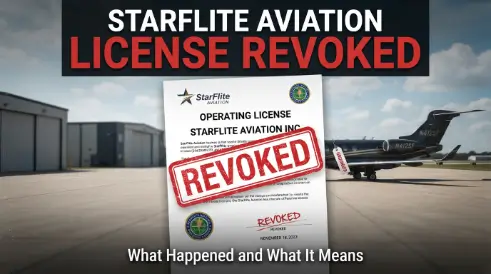
On February 27, 2026, the FAA announced that it had issued an emergency order immediately revoking the Air Carrier Certificate of StarFlite Aviation, a Part 135 operator based in Houston, Texas.
The FAA said the decision was based on findings involving falsified pilot training records and concerns about the company’s management structure.
The agency alleged that between November 2019 and November 2024, management personnel made numerous false entries in the training records of at least 10 pilots. According to the FAA, those entries indicated that check rides and competency checks had been completed in different aircraft when the required activities had not actually occurred.
The FAA further stated that these records resulted in StarFlite using unqualified pilots for at least 170 flights.
The agency also said that StarFlite lacked qualified management personnel capable of ensuring the safety of its operations.
These findings led to the emergency revocation rather than an ordinary administrative change to the company’s certificate.
What Does “License Revoked” Mean in This Case?
People often use the word “license” when discussing aviation companies, but the specific regulatory document involved here was StarFlite Aviation’s Air Carrier Certificate.
StarFlite operated under FAA rules for Part 135 operators. Part 135 covers certain commercial air transportation operations, including many charter and on-demand services.
An air carrier certificate is important because it authorizes an operator to conduct particular types of commercial flight operations under the conditions established by the FAA.
When the FAA revokes that certificate, the operator cannot continue those certified operations as it previously did under that authorization.
The StarFlite action was particularly significant because the FAA issued an emergency order, meaning the revocation took effect immediately.
Why Are Pilot Training Records So Important?
Pilot training records may look like paperwork, but they are a major part of aviation safety.
Pilots operating commercial aircraft must meet specific qualification and training requirements. Depending on the aircraft and operation, pilots may need recurrent training, competency checks, proficiency evaluations, and other forms of qualification.
These records provide evidence that required training and checks have actually taken place.
A training record is therefore more than an administrative document. It helps an airline, charter company, regulator, and other aviation professionals determine whether a pilot is properly qualified for a particular operation.
If a record incorrectly states that a check was completed, people reviewing the paperwork may believe that the pilot has met a requirement when that may not be the case.
That is why the FAA treated the alleged recordkeeping issues at StarFlite as a serious safety matter.
The FAA’s Allegations Against StarFlite
It is important to distinguish between allegations made by a regulator and a final finding after any appeal or other legal process.
The FAA alleges that StarFlite management knowingly falsified training records between November 2019 and November 2024.
The agency said at least 10 pilots were affected, including the chief pilot. It also alleged that false entries indicated that check rides and competency checks had taken place in aircraft when they had not.
The FAA then connected those records to at least 170 flights involving pilots it considered unqualified.
These are the core allegations behind the emergency action.
The FAA also stated that it found StarFlite did not have qualified management personnel necessary to ensure safe operations. The agency said the company’s conduct demonstrated a disregard for the safety of the flying public.
How Long Did the Alleged Record Problems Continue?
According to the FAA, the alleged false entries covered a period from November 2019 through November 2024.
That represents roughly five years.
The length of the period is one reason the case has received attention. The allegations do not concern a single isolated training document. Instead, the FAA described numerous entries involving multiple pilots over an extended period.
The agency’s statement specifically identified at least 10 pilots and at least 170 flights connected to the alleged qualification problems.
What Is Part 135?
To understand the StarFlite case, it helps to understand what Part 135 means.
Part 135 is a section of U.S. aviation regulations covering certain commuter and on-demand operations. Many charter companies operate under this framework.
These operations are different from the large scheduled airlines most travelers know.
A charter company may operate private flights for customers, businesses, groups, or other clients. The exact operation depends on the certificate and authorizations held by the company.
Because these flights carry passengers commercially, operators must comply with FAA requirements involving areas such as aircraft maintenance, pilot qualifications, training, operational procedures, and management.
The StarFlite case demonstrates why those requirements are important.
What Is an Emergency Order?
An emergency order is a regulatory action that can take effect immediately when the FAA determines that urgent action is necessary.
In StarFlite’s case, the FAA did not simply announce a future review of the company’s certificate. It issued an emergency order immediately revoking the Air Carrier Certificate.
This allowed the agency to stop the operator from continuing the certified operations covered by the revoked certificate while the regulatory process continued.
The FAA also stated that StarFlite has the right to appeal the emergency order by filing a notice with the National Transportation Safety Board (NTSB).
That appeal option is important because it means the regulatory process does not necessarily end with the FAA’s initial emergency action.
Could StarFlite Appeal the Decision?
Yes.
The FAA’s announcement specifically says StarFlite may appeal the Emergency Order by filing a notice with the NTSB.
An appeal provides a formal process through which the company can challenge the FAA’s action.
This is also why articles about the case should use careful language. Saying that the FAA alleged that records were falsified is different from independently declaring every allegation to be a final adjudicated fact.
For readers following the case, future NTSB proceedings or additional FAA announcements may provide further information about the outcome.
What Happened to StarFlite’s Aircraft?
The company’s aircraft situation has also received attention.
Industry publication ch-aviation reported that, according to the most recent FAA information it reviewed, StarFlite’s Part 135 certificate had been associated with a Piper PA-31, registration N713WT. The publication also reported that several aircraft previously associated with StarFlite had moved to other operators or were no longer listed under StarFlite’s certificate.
This illustrates an important point: an aircraft’s ownership or location and an operator’s certificate are not necessarily the same thing.
Aircraft can change operators, certificates, owners, or management arrangements over time.
Therefore, seeing an aircraft previously associated with StarFlite does not automatically mean that it is still being operated under StarFlite’s Part 135 certificate.
What Does the Case Mean for Passengers?
For passengers, the biggest lesson is the importance of checking the current status of a charter operator before booking a flight.
When using a private charter company, customers can ask about the operator’s certification and the aircraft being used for the trip.
Travelers should also confirm who the actual operating carrier is. A company arranging a private flight and the company physically operating the aircraft are not always the same business.
This distinction can be especially important when booking through brokers or third-party charter platforms.
If a passenger has an upcoming booking connected to an operator affected by regulatory action, contacting the booking company and asking for written information about the actual operating carrier is a sensible step.
Why Accurate Aviation Records Matter
Aviation depends on documentation.
Aircraft maintenance records show what work has been performed. Flight records document operations. Pilot records demonstrate training and qualification. Company records provide regulators with evidence that safety requirements are being followed.
The system works because people can rely on those records.
If records are inaccurate, the problem can go beyond paperwork. An incorrect record can affect decisions made by managers, pilots, dispatch personnel, regulators, and other safety professionals.
That is why allegations involving falsified pilot training records are taken seriously by aviation authorities.
What the FAA Found About Management
The training records were not the only issue identified by the FAA.
The agency also said StarFlite lacked qualified management personnel needed to ensure safe operations.
A commercial aviation operator needs more than qualified pilots. It also requires an organizational structure capable of managing safety, training, maintenance, operations, and compliance.
Management personnel have important responsibilities in maintaining the operator’s standards.
If regulators determine that an operator does not have the appropriate management structure, that can become a major regulatory concern.
In the StarFlite case, the FAA cited both the alleged training-record problems and the lack of qualified management personnel when explaining its emergency action.
What Aviation Experts Have Said
News reports following the FAA announcement have also included comments from aviation professionals about the importance of pilot competency checks.
ABC13 Houston interviewed former commercial airline pilot Richard Levy, who described check rides and competency checks as important safety measures used to verify that pilots can properly perform their duties.
His comments provide context for why regulators place significant importance on training and competency records.
However, expert commentary should be distinguished from the FAA’s official findings and allegations.
What Happens Next?
The next stage depends partly on whether StarFlite appeals the FAA’s emergency order and what happens through the regulatory process.
The FAA has already taken the immediate action of revoking the certificate. Any appeal could provide additional information about the company’s position and the agency’s evidence.
Future regulatory documents could also clarify whether the emergency order remains in effect, is modified, or is otherwise resolved.
For now, the FAA’s February 27, 2026 announcement remains the central official source for understanding why the emergency revocation occurred.
What Travelers Should Check Before Booking a Charter
The StarFlite situation provides a useful reminder for anyone considering private air charter.
Before booking, travelers should verify the operating carrier rather than relying only on the name of a broker or booking website.
It is also worth confirming that the operator has the appropriate FAA authorization for the type of flight being offered.
Customers can ask who will actually operate the aircraft, what aircraft will be used, and whether the operator is currently authorized to conduct the proposed service.
These questions do not guarantee that every aspect of a flight will be perfect, but they can help travelers make better-informed choices.
Frequently Asked Questions
Why was StarFlite Aviation’s certificate revoked?
The FAA issued an emergency order on February 27, 2026, alleging that StarFlite management knowingly falsified pilot training records. The agency said the alleged records involved at least 10 pilots and that unqualified pilots were used on at least 170 flights.
When did the alleged training-record problems occur?
The FAA says the alleged false entries were made between November 2019 and November 2024.
Can StarFlite challenge the revocation?
Yes. The FAA stated that StarFlite may appeal the Emergency Order by filing a notice with the National Transportation Safety Board.
Was every StarFlite pilot affected?
The FAA specifically said its allegations involved at least 10 pilots, including the chief pilot. That does not mean every pilot associated with the company was necessarily involved in the alleged recordkeeping issues.
What does the case mean for charter passengers?
The immediate regulatory action means travelers should carefully verify the current operating carrier and authorization of any charter flight they are considering. The case also highlights the importance of proper pilot training records and qualified management in commercial aviation.
Final Thoughts
The StarFlite Aviation license revoked story is significant because it involves the FAA’s emergency revocation of a commercial air carrier certificate following allegations concerning pilot training records and operational management.
According to the FAA, management personnel allegedly made false training entries involving at least 10 pilots over a period from 2019 to 2024. The agency said those records represented check rides and competency checks that had not actually occurred and linked the issue to at least 170 flights involving pilots the FAA considered unqualified.
At the same time, the distinction between an allegation and a final adjudicated finding remains important. StarFlite has the right to appeal the FAA’s emergency order through the NTSB process.
For the broader aviation industry, the case demonstrates why accurate training records, qualified management, and regulatory oversight are fundamental parts of commercial flight safety.
For passengers, the situation is a reminder to verify an operator’s current certification and identify the actual company operating a charter flight before booking.
As the regulatory process develops, additional information may clarify the company’s response and the final outcome of the case.