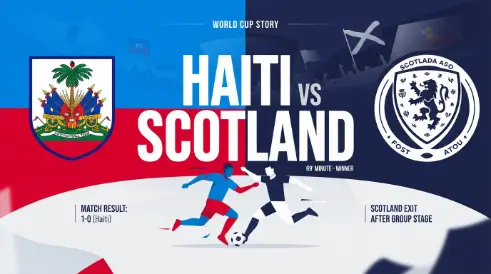
The Haiti vs Scotland match became one of the most memorable opening games of the 2026 FIFA World Cup, not only because of the result but also because both teams were returning to the tournament after long absences. Haiti were back at the World Cup for the first time since 1974, while Scotland were appearing at the finals for the first time since 1998. The meeting in Boston therefore carried plenty of history before the first whistle.
The match took place at Boston Stadium on Saturday, June 13, 2026, as part of Group C. Scotland eventually won 1-0, with John McGinn scoring the only goal of the game in the first half. The narrow scoreline, however, does not tell the whole story. Haiti competed strongly, created pressure late in the match, and showed why their return to the World Cup was about much more than simply taking part.
Haiti vs Scotland Match Result
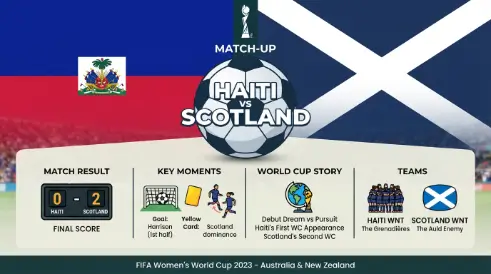
The final score was:
Haiti 0-1 Scotland
John McGinn scored Scotland’s winning goal in the 29th minute. The goal came after Che Adams had an effort saved by Haiti goalkeeper Johny Placide. The loose ball reached McGinn, whose shot took a deflection and went into the net.
Scotland had another excellent opportunity before the goal when Scott McTominay hit the post in the 17th minute. Haiti survived that moment and grew into the match as the game continued.
Despite Scotland having the lead, Haiti did not simply sit back and accept defeat. The Caribbean side continued to attack and created moments that kept Scotland under pressure during the closing stages.
For Scotland, the important thing was getting three points from their first World Cup match. For Haiti, the performance showed that they could compete on football‘s biggest stage.
A Historic World Cup Meeting
One of the most interesting facts about Haiti vs Scotland is that the 2026 World Cup match was the first senior international meeting between the two countries.
That made the game unusual even before considering the teams’ long World Cup absences. FIFA’s match preview confirmed that neither side had previously faced the other at senior level.
Haiti had only appeared at one previous World Cup, in West Germany in 1974. That tournament remained the country’s only appearance for more than five decades.
Scotland had a much longer World Cup history, but their last appearance before 2026 came at France 1998. Their return to the tournament therefore ended a 28-year wait.
The contrast made the match particularly interesting. Haiti were returning after 52 years, while Scotland were ending a 28-year absence.
Why Haiti’s Return Was So Important
For Haiti, qualifying for the 2026 World Cup was already a major achievement.
The team had not played at the finals since 1974, meaning an entire generation of Haitian supporters had never seen their national team compete at a World Cup.
The road to qualification was also complicated by circumstances away from football. Haiti’s national team had been forced to play qualifying matches outside the country because of security problems. The Guardian reported that the team had to stage its home qualifiers in Curaçao.
That made the qualification campaign particularly challenging.
Instead of having regular home matches surrounded by local supporters, Haiti often had to operate away from home. Yet the team managed to qualify and earn a place among the 48 nations at the expanded 2026 World Cup.
The Haiti vs Scotland match was therefore more than the opening game of a tournament. It represented a return to a stage the country had not reached for more than half a century.
Scotland’s Long Wait Was Different
Scotland’s wait for another World Cup was considerably shorter, but it was still a major moment for Scottish football.
Their previous appearance was at France 1998. They had qualified for several major European tournaments during the years that followed, but the World Cup remained out of reach.
Scotland eventually secured their place at the 2026 tournament through European qualifying. FIFA’s team profile notes that their qualification campaign included a 4-2 victory over Denmark in the final match, helping them return to the finals.
The Haiti vs Scotland game therefore gave Scottish supporters something they had waited nearly three decades to see: their national team playing at the World Cup again.
How Scotland Scored
The only goal came in the 29th minute.
Scotland had already threatened Haiti’s goal several times. McTominay’s shot against the post was the clearest earlier opportunity.
When Scotland eventually scored, Che Adams was involved in the move. His effort was saved by Placide, but the ball remained available inside the penalty area.
McGinn reacted quickly and struck the ball. A deflection changed its path and sent it beyond the Haiti goalkeeper.
The Scottish Football Association recorded McGinn as the scorer and described the goal as the decisive moment of the match.
It was not the cleanest goal Scotland will ever score, but it was enough to give them three points.
Haiti’s Performance
The 1-0 defeat might suggest that Haiti were comfortably beaten, but the match itself was more competitive than the final score indicates.
FIFA reported that Haiti defended with discipline and organization. The team allowed Scotland only two particularly clear opportunities: McTominay’s shot that hit the post and the McGinn goal.
Haiti also had a strong share of possession. FIFA’s match report recorded the possession split at 47% for Haiti and 43% for Scotland, with the remaining percentage classified as contested.
That statistic is important because it shows that Haiti were not simply defending for the entire match.
They were willing to keep the ball, move forward and challenge Scotland.
Key Players for Haiti
Haiti entered the tournament with several players capable of causing problems for opposing defenses.
Jean-Ricner Bellegarde was one of the important names in the squad. The midfielder had experience playing in English football and was expected to provide energy and creativity in the middle of the pitch.
Wilson Isidor was another player attracting attention before the tournament. The forward had developed a reputation as one of Haiti’s important attacking players. BBC Sport also highlighted players such as Bellegarde and Isidor when previewing the match.
Veteran goalkeeper Johny Placide was another key figure. His saves helped keep Haiti in the match after Scotland created early opportunities.
Frantzdy Pierrot also represented an important attacking option for Haiti.
Together, these players gave the team a mixture of experience, pace and physical strength.
Key Players for Scotland
Scotland also entered the game with a group of experienced international players.
Scott McTominay was one of the central figures. His ability to contribute both defensively and offensively made him an important part of Scotland’s midfield.
Andy Robertson provided experience and attacking width from the left side, while John McGinn brought leadership and creativity.
McGinn ultimately became the headline player because his goal decided the match.
His strike also had historical importance. Reuters reported that the goal made McGinn the oldest Scottish player to score at a World Cup.
For a player already known for his importance to Scotland, scoring the winning goal in the country’s World Cup return was a particularly memorable moment.
Tactical Battle Between Haiti and Scotland
The tactical contrast was one of the interesting parts of the match.
Haiti’s approach relied heavily on organization, quick transitions and attacking pace. Their team had been shaped under coach Sébastien Migné to defend in an organized way before moving forward quickly when opportunities appeared.
Scotland, meanwhile, had more experience playing against European opposition and entered the tournament with a squad containing several established international players.
The match eventually became a battle between Scotland’s experience and Haiti’s energy.
Scotland were able to create enough chances to score, but Haiti’s defensive structure prevented the game from becoming one-sided.
The Importance of the First Goal
In a World Cup group match, the first goal can completely change the tactical situation.
Scotland’s goal allowed them to become more conservative as the match progressed. Haiti, on the other hand, had to take greater risks because they needed an equalizer.
That created more space for counterattacks.
Haiti continued pushing during the closing stages and came close to finding a way back into the game. FIFA described the team as going close to restoring parity before the final whistle.
Scotland’s defense and goalkeeper Angus Gunn managed to hold on.
Scotland’s First World Cup Win Since 1990
The victory had another important historical detail.
It was Scotland’s first World Cup victory since 1990.
Reuters reported that Scotland had gone 36 years without winning a match at the World Cup before defeating Haiti.
That made the 1-0 result more significant than a simple opening-game victory.
Scotland had spent decades struggling to make an impact at the tournament. Winning their first game on their return gave supporters a memorable moment and three valuable points.
What the Result Meant for Group C
The Haiti vs Scotland result was especially important because Group C also contained Brazil and Morocco.
Scotland’s three points gave them an excellent starting position in the group standings, while Haiti were left needing results in their remaining matches.
The other Group C game on the same matchday ended Brazil 1-1 Morocco, meaning both teams dropped points.
That made Scotland’s victory even more valuable from a group-stage perspective.
Haiti, meanwhile, still had opportunities to compete for points in their remaining matches.
Haiti’s Bigger Story
The final score should not overshadow what Haiti achieved by reaching the World Cup.
The team had spent decades waiting for another opportunity to compete at the finals.
Their qualification came during a difficult period for the country, making the tournament appearance an important source of national pride for many Haitians and members of the Haitian diaspora.
FIFA described the team’s attitude after the defeat in terms of courage and competitiveness. Jean-Ricner Bellegarde, who was involved in the unfortunate deflection on Scotland’s goal, emphasized the need for the team to remain positive.
That response captured the spirit surrounding Haiti’s return.
Losing the opening match was disappointing, but simply reaching the World Cup after such a long absence remained a significant achievement.
What Scotland Could Take From the Match
Scotland could take confidence from several aspects of the result.
Most importantly, they won.
Their defense also produced a clean sheet, while their midfield created enough chances to threaten Haiti’s goal.
However, the narrow scoreline also showed that Scotland could not afford to become complacent against opponents willing to attack.
The World Cup group stage provides little room for wasted opportunities, and Scotland’s next opponents included Morocco and Brazil. FIFA’s tournament schedule confirmed those matches for June 19 and June 24 respectively.
The victory over Haiti gave Scotland a strong starting point, but the group would become much more difficult from there.
Final Thoughts
The Haiti vs Scotland match will be remembered for several reasons.
Scotland returned to the World Cup after 28 years and immediately recorded a victory. Haiti returned after an extraordinary 52-year absence and produced a competitive performance against a more experienced opponent.
John McGinn’s 29th-minute goal separated the teams, while Scotland’s defense protected the lead until the final whistle.
For Scotland, the result ended a long wait for a World Cup win and gave them three important Group C points.
For Haiti, the match marked the beginning of a new World Cup chapter. Despite the defeat, the team’s organization, possession and determination showed that their qualification was not simply a ceremonial return.
The game also demonstrated why World Cup football remains so compelling. Two nations with very different football histories met for the first time, both carrying decades of expectation into a single match.
In the end, Scotland had the winning moment through McGinn, but Haiti left the field with plenty of reasons to believe they belonged on the world’s biggest football stage.