A research dossier for target company is a structured collection of information about a business, its market, competitors, leadership, products, financial position, reputation, and future direction. It is commonly used before making an important business decision, starting a partnership, approaching a potential client, conducting sales research, or evaluating an investment opportunity.
A good dossier is much more than a collection of facts copied from a company website. It brings information together from different sources and organizes it in a way that makes the company easier to understand.
Whether you are researching a small startup or a large international corporation, the basic idea remains the same: collect reliable information, check the facts, identify important patterns, and turn the findings into useful conclusions.
This guide explains how to create a useful research dossier for target company from beginning to end.
What Is a Research Dossier for Target Company?
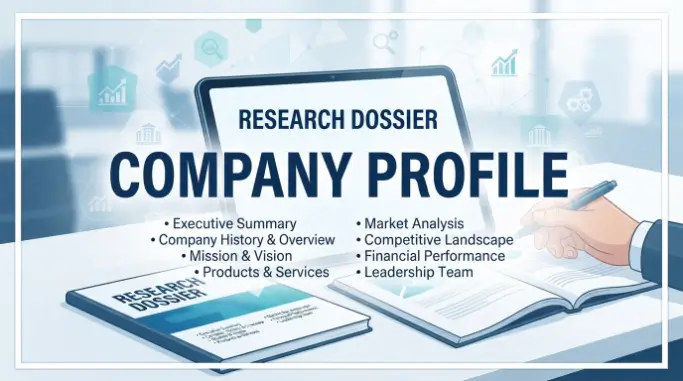
A research dossier for target company is a detailed research document prepared to give someone a clear picture of a particular business.
Think of it as a business background file.
Instead of searching through dozens of websites, news stories, company reports, social media accounts, and public records every time you need information, the dossier brings the most important details together in one place.
A typical dossier may contain information about the company’s history, ownership, management team, products, customers, competitors, financial performance, market position, recent news, online reputation, and potential risks.
The exact information depends on why the research is being performed.
For example, a sales professional researching a potential client may care more about the company’s decision-makers, recent expansion, technology stack, and business challenges. An investor may focus more heavily on revenue, profitability, debt, ownership, and market conditions.
The purpose should therefore be decided before research begins.
Why Create a Company Research Dossier?
Business decisions are often made with incomplete information. A company may look successful from the outside while facing serious internal challenges. On the other hand, a relatively unknown business may have strong growth potential that is not immediately obvious.
Research helps reduce this uncertainty.
A detailed dossier can help you understand:
- Who owns the company
- What products or services it provides
- Who its customers are
- Where it operates
- Who its competitors are
- How it makes money
- What its strengths and weaknesses may be
- What recent changes have occurred
- Which risks deserve attention
This information becomes particularly valuable when the target company is being considered for a partnership, acquisition, investment, supplier relationship, or major sales opportunity.
Start With the Company’s Basic Information
The first section should provide a simple overview.
Begin with the company’s official name and, where relevant, its trading name or brand names. Then record its headquarters, founding year, industry, website, major locations, and basic business model.
If the company has several subsidiaries or brands, document those relationships as well.
This section should be easy to read because it gives the reader immediate context.
For example, a basic company profile might explain that a business was founded in 2015, operates in the software industry, serves customers in North America and Europe, and earns revenue through monthly subscriptions.
Do not make this section unnecessarily complicated. Its job is to establish the basic identity of the target company.
Research the Company’s History
A company’s history often explains why it operates the way it does today.
Look for important events such as its founding, major product launches, acquisitions, mergers, leadership changes, funding rounds, international expansion, and major changes in strategy.
A timeline can be particularly useful.
Rather than writing several pages about the company’s past, identify the events that actually influenced its development.
For example, an acquisition may have given the business access to a new technology or customer base. A leadership change may have resulted in a different business strategy. A major product failure may explain why the company later moved into another market.
The goal is not simply to collect dates. It is to understand the story behind the company.
Examine the Company’s Products and Services
Next, study what the company actually sells.
List its major products or services and explain what each one does. Try to understand which products appear to be central to the business and which are secondary.
Questions worth asking include:
What problem does the product solve?
Who normally buys it?
How is it priced?
How does the company distribute it?
What makes the product different from competing options?
Does the company depend heavily on one product?
These questions can reveal important information about the company’s business model.
A company with one product generating most of its revenue may face a different risk profile from a diversified company with several strong product lines.
Identify the Target Company’s Customers
Understanding customers is one of the most useful parts of a company dossier.
A business may sell directly to consumers, serve other businesses, work with governments, or use a combination of these models.
Look at the company’s customer segments and identify its most important markets.
For a business-to-business company, research the industries it serves and the size of its typical customers. For a consumer brand, look at demographics, geographic markets, purchasing behavior, and customer preferences.
Customer concentration is also worth considering.
If a company depends heavily on a small number of major customers, losing one large account could have a significant impact.
Study the Management Team
Leadership can have a major influence on a company’s direction.
Research the chief executive, founders, senior executives, board members, and other important decision-makers.
Look at their professional backgrounds, previous companies, areas of expertise, and time spent with the target company.
You should also pay attention to recent leadership changes.
A new CEO, chief financial officer, or head of technology can sometimes signal a major strategic shift.
However, avoid making conclusions based only on job titles. Look at the person’s actual experience and responsibilities.
Analyze the Company’s Competitors
No company operates in isolation.
A strong research dossier for target company should explain the competitive environment surrounding the business.
Start by identifying its direct competitors. Then look at indirect competitors that solve the same customer problem in a different way.
For each major competitor, compare areas such as:
- Products
- Pricing
- Geographic reach
- Customer base
- Brand reputation
- Technology
- Distribution
- Market positioning
The purpose is not to create a giant competitor database.
Instead, identify the companies that could realistically affect the target company’s future.
Research the Industry
The target company cannot be properly understood without looking at its industry.
Research current industry trends, market growth, customer behavior, technology changes, regulations, and major challenges.
For example, a technology company may be affected by artificial intelligence, cybersecurity requirements, cloud adoption, or changing software development practices.
A food company may be influenced by ingredient costs, consumer preferences, supply-chain conditions, and food regulations.
Industry research helps separate company-specific problems from wider market problems.
If several competitors are experiencing the same challenge, it may indicate an industry-wide issue rather than poor management at the target company.
Examine Financial Information
Financial research is essential when reliable financial data is publicly available.
Look for revenue, profit, operating costs, debt, cash, assets, funding, and other useful financial measures.
Public companies generally provide much more information through annual reports and regulatory filings than private companies.
For private businesses, available information may be limited. In that situation, do not present estimates as confirmed facts.
Instead, clearly label information as reported, estimated, or unavailable.
Look for trends rather than focusing on one number.
For example, rising revenue is encouraging, but it becomes more meaningful when considered alongside profitability, cash flow, debt, and operating costs.
Look at Recent News
A company dossier should not rely entirely on old information.
Search for recent developments involving the target company. These might include product announcements, lawsuits, acquisitions, layoffs, new contracts, partnerships, leadership changes, regulatory actions, or expansion plans.
Recent news can sometimes change the interpretation of older information.
A company that appeared to be expanding aggressively six months ago may have since changed direction.
For this reason, establish a clear research date and record when important information was published.
Investigate Online Reputation
A company’s reputation can influence customer decisions, partnerships, recruitment, and long-term growth.
Look beyond the company’s own marketing material.
Read customer reviews, industry discussions, professional publications, and relevant social media conversations.
However, individual reviews should not automatically be treated as proof of a widespread problem.
Look for patterns.
If hundreds of customers repeatedly mention the same issue, it deserves more attention than one anonymous complaint.
The same principle applies to positive feedback. A handful of enthusiastic comments does not necessarily prove that a company has an excellent reputation.
Review the Company’s Online Presence
A company’s website and digital presence can reveal useful information about its current priorities.
Review the official website, product pages, careers section, press releases, blog, social media accounts, and investor pages where available.
Pay attention to what the company talks about most.
If a technology business suddenly begins publishing heavily about artificial intelligence, for example, this could indicate a strategic focus on that area.
The careers page can also provide clues. A large number of openings in a particular department may suggest expansion or investment in that function.
These observations should be treated as signals rather than confirmed facts unless supported by stronger evidence.
Check Legal and Regulatory Information
Depending on the purpose of the research, legal information may be extremely important.
Search for publicly available court records, regulatory announcements, government filings, intellectual property disputes, and enforcement actions.
This is particularly important when researching companies in heavily regulated industries such as finance, healthcare, pharmaceuticals, telecommunications, and energy.
Always distinguish between an allegation, a lawsuit, a regulatory investigation, and a final judgment.
Using precise language prevents the dossier from presenting an unresolved claim as an established fact.
Identify Strengths and Weaknesses
After collecting the information, step back and evaluate the company.
A useful dossier should not simply repeat what the company says about itself.
Identify genuine strengths.
These might include a strong brand, loyal customers, valuable technology, experienced leadership, efficient distribution, or a strong financial position.
Then consider potential weaknesses.
These could include customer concentration, dependence on one product, high costs, regulatory exposure, weak market position, limited geographic reach, or strong competitive pressure.
The analysis should be based on evidence gathered during the research.
Identify Opportunities and Risks
The final analytical sections should focus on the future.
Potential opportunities may come from new markets, product launches, technological changes, partnerships, customer growth, or favorable industry trends.
Risks could include new competitors, regulation, economic conditions, changing customer behavior, cybersecurity problems, supply-chain disruptions, or technological disruption.
A simple risk table can make this section easier to understand.
| Area | Potential Opportunity | Potential Risk |
|---|---|---|
| Technology | New technology adoption | Rapid technological change |
| Market | Expansion into new regions | Increased competition |
| Products | New product launches | Product failure |
| Customers | Customer growth | Customer concentration |
| Operations | Greater efficiency | Supply-chain disruption |
How to Organize the Final Dossier
A professional dossier should be organized logically.
A useful structure is:
- Executive summary
- Company overview
- History and timeline
- Products and services
- Customers and markets
- Leadership
- Competitors
- Industry analysis
- Financial information
- Recent developments
- Reputation
- Legal and regulatory information
- Strengths and weaknesses
- Opportunities and risks
- Final assessment
- Sources
The executive summary should be written last because you will understand the company much better after completing the research.
Keep Sources Organized
Good research depends on good sources.
Whenever you record an important fact, save the source where you found it. Official company reports, government records, regulatory filings, reputable news organizations, industry publications, and original research are generally more useful than anonymous posts.
Do not rely on a single source for important claims when independent confirmation is possible.
It is also helpful to record the publication date. Information about companies changes quickly, and an old source may no longer describe the current situation.
Common Mistakes to Avoid
One common mistake is copying the company’s marketing language and treating it as independent analysis.
Another is relying on outdated information.
A third mistake is confusing assumptions with facts. If you cannot verify something, say so rather than filling the gap with speculation.
Researchers should also avoid spending too much time collecting information that has no connection to the purpose of the dossier.
A good research dossier is not necessarily the longest one. It is the one that helps the reader understand the company and make a better decision.
Final Thoughts
Creating a research dossier for target company is a practical way to turn scattered business information into a clear and useful profile.
The strongest dossiers combine basic company information with deeper research into products, customers, leadership, competitors, finances, industry trends, reputation, legal matters, opportunities, and risks.
The key is to remain objective. A company website can explain what a business wants customers to know, but independent sources can help you understand the bigger picture.
Take time to verify important claims, record your sources, separate facts from estimates, and pay attention to recent developments. Most importantly, build the dossier around the decision you are trying to make.
When done properly, a company research dossier becomes more than a document. It becomes a practical tool for understanding a business, spotting opportunities, recognizing risks, and making informed decisions with greater confidence.