
The Costa de Marfil vs. Noruega matchup was one of the interesting knockout games of the 2026 FIFA World Cup. Both teams arrived with different football identities but had the same objective: reach the next round and keep their World Cup campaign alive.
Costa de Marfil brought a strong African squad with physical strength, pace, and talented attacking players. Norway, meanwhile, had one of the most talked-about strikers in world football in Erling Haaland, along with creative players such as Martin Ødegaard.
The match took place at AT&T Stadium in Arlington, Texas, on June 30, 2026. Norway eventually won 2–1, with Antonio Nusa and Erling Haaland scoring for the European side and Amad Diallo scoring for Costa de Marfil. The reported attendance was 69,665.
Although the final score was close, the game showed why both teams were considered dangerous opponents. Costa de Marfil had enough quality to create problems, while Norway had the individual attacking talent to decide the match.
Costa de Marfil vs. Noruega at a Glance
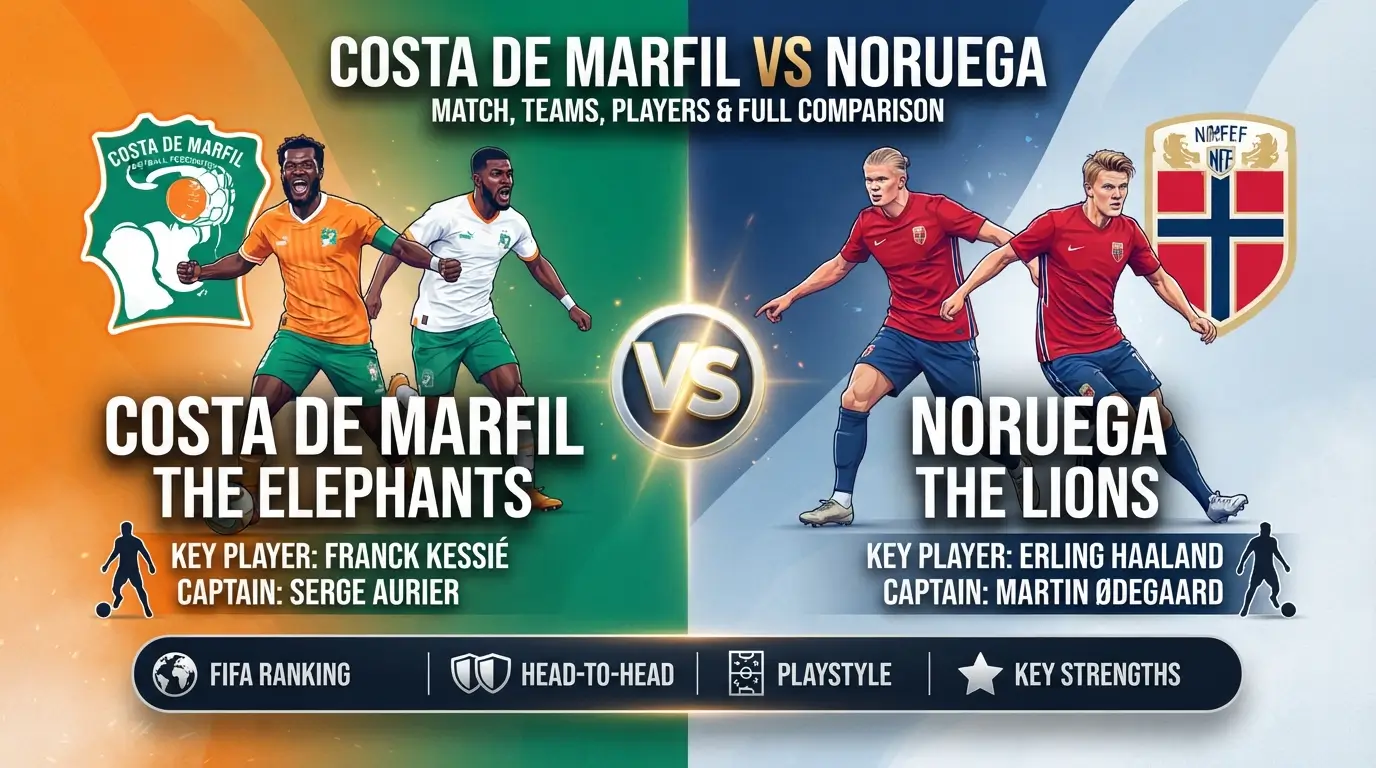
The Costa de Marfil vs. Noruega game was played in the Round of 32 at the 2026 World Cup. This was an important change to the traditional tournament format because the expanded 2026 World Cup introduced a Round of 32 before the traditional Round of 16.
Costa de Marfil reached the knockout stage after finishing second in its group. Norway also finished second in its group and advanced to the same stage.
According to match previews published before the game, Costa de Marfil had collected six points in the group stage, scoring four goals and conceding two. Norway also had six points, but its group campaign produced eight goals for and seven against.
That difference gave the match an interesting contrast. Costa de Marfil had shown a relatively strong defensive record, while Norway had demonstrated greater attacking output.
How Costa de Marfil Reached the Knockout Stage
Costa de Marfil entered the knockout round after a competitive group campaign. The team showed that it could compete against strong opposition and remain organized under pressure.
The Ivorian side had several experienced players who could control important moments of a match. Franck Kessié provided experience in midfield, while Amad Diallo offered pace and creativity in attack.
The team also had Nicolas Pépé, who remained an important attacking option. Before the Norway match, Pépé had scored twice during the tournament, making him one of Costa de Marfil’s key goal threats.
One of the team’s biggest strengths was its ability to combine physical play with technical quality. African teams are often praised for athleticism, but Costa de Marfil showed that it could also build attacks through midfield and use quick passing when space became available.
Norway’s Road to the Knockout Stage
Norway arrived at the Costa de Marfil vs. Noruega match with plenty of confidence.
The Norwegian team had earned six points in its group and scored eight goals. Its attacking numbers were particularly impressive, with Erling Haaland leading the way.
Haaland scored four goals in only two group matches. He did not play in Norway’s final group game against France because the Norwegian coaching staff rotated players ahead of the knockout stage.
That decision meant Norway could enter the knockout match with its main attacking star rested.
Martin Ødegaard was another important part of Norway’s team. His ability to find space, control possession, and create chances gave Norway an additional attacking dimension.
Erling Haaland Was the Main Threat
Whenever Norway plays a major tournament match, Erling Haaland naturally receives much of the attention.
His combination of size, speed, movement, and finishing ability makes him difficult for defenders to handle. During the 2026 World Cup group stage, he had already scored four times before facing Costa de Marfil.
That record meant Costa de Marfil had to pay close attention to him.
A defender cannot simply follow Haaland everywhere because doing so can create space for other Norwegian attackers. At the same time, giving him too much room inside the penalty area can be even more dangerous.
This tactical problem was one of the central themes of the match.
Haaland eventually made the difference by scoring Norway’s second goal in the 86th minute.
Costa de Marfil’s Key Players
Costa de Marfil had several players capable of changing the match.
Amad Diallo was particularly important. The winger brought pace and direct attacking ability, allowing Costa de Marfil to threaten Norway’s defense from wide areas.
Diallo scored Costa de Marfil’s goal in the 74th minute, giving the African side renewed hope late in the match.
Franck Kessié was also an important figure. His experience and physical presence helped Costa de Marfil compete in midfield.
Nicolas Pépé provided another attacking option. His experience at the international level gave the team additional creativity around the penalty area.
Together, these players gave Costa de Marfil enough attacking quality to remain competitive even when Norway controlled parts of the game.
How the Match Developed
The game started with both teams aware of the importance of the occasion. Neither side could afford to make unnecessary mistakes because one poor defensive moment could end a World Cup campaign.
Norway eventually found the breakthrough through Antonio Nusa. He scored in the 39th minute, giving Norway a 1–0 lead before halftime.
Costa de Marfil responded after the break and became increasingly dangerous.
The Ivorian team found its equalizer through Amad Diallo in the 74th minute. At 1–1, the match suddenly became much more open.
Both sides knew that another goal could decide everything.
That decisive moment came in the 86th minute when Haaland scored for Norway. His late goal restored Norway’s lead and ultimately sent the team through to the next round.
Costa de Marfil vs. Noruega Match Statistics
The final result was 2–1 in favor of Norway, but the underlying numbers show that the game was competitive.
One statistical source reported Costa de Marfil with 47% possession compared with Norway’s 53%. Costa de Marfil registered 14 total shots, while Norway had nine. However, Norway produced more expected goals, listed at 2.02 compared with 1.36 for Costa de Marfil.
These numbers are interesting because Costa de Marfil actually attempted more shots.
Norway’s advantage came from the quality and danger of its chances. This is a good example of why simply counting shots does not always explain the final result.
A team can shoot more often but still lose if its chances are less dangerous.
Costa de Marfil’s Strengths
Costa de Marfil’s biggest strength was its physical and technical balance.
The team had players who could compete in midfield while also moving quickly into attack. Its wide players could stretch Norway’s defense, while experienced midfielders provided stability.
The team also showed resilience.
After going behind 1–0, Costa de Marfil did not collapse. Instead, it continued attacking and eventually found an equalizer.
That mentality is important in knockout football because teams often have to recover from difficult moments.
The problem was that Costa de Marfil could not maintain that momentum for the final stages of the match.
Norway’s Strengths
Norway’s biggest advantage was its attacking quality.
Having a striker such as Haaland changes how an opponent has to defend. His presence can create opportunities even when he is not touching the ball.
Norway also had creative midfielders capable of supplying attackers.
The team’s 53% possession against Costa de Marfil was not overwhelming, but it was enough to help Norway control important parts of the match.
Most importantly, Norway had players capable of producing a decisive moment.
That quality proved crucial in the final minutes.
FIFA Ranking Comparison
Before comparing the two national teams, it is useful to look at their FIFA rankings.
In the latest official FIFA ranking available in the sources, Norway was ranked 19th, while Côte d’Ivoire was ranked 31st. FIFA lists Norway’s highest historical position as second and Côte d’Ivoire’s as 12th.
The ranking difference suggests that Norway entered the tournament with a stronger position in the global rankings.
However, rankings do not guarantee a match result. A knockout game can be decided by one goal, one mistake, or one exceptional individual performance.
The Costa de Marfil vs. Noruega result demonstrated exactly that. Both teams were competitive, but Norway found the decisive goal when it mattered most.
Different Football Styles
Another interesting part of this matchup was the contrast between the two football cultures.
Costa de Marfil traditionally produces technically gifted and physically powerful players. The national team has often relied on athleticism, quick transitions, and individual creativity.
Norway’s modern team has a different profile. It combines physical strength with structured possession and high-level attacking talent.
The presence of Haaland gives Norway a direct option that can change its approach quickly. The team can build patiently but also play forward when the opportunity appears.
This tactical contrast made the match especially interesting.
What the Result Means for Both Teams
For Norway, the 2–1 victory represented another step in an important World Cup campaign. The team had returned to the World Cup after a long absence and was determined to make the opportunity count.
For Costa de Marfil, the defeat was disappointing because the team had shown enough quality to believe it could continue further.
Still, reaching the knockout stage was a positive achievement.
The Ivorian side demonstrated that it could compete against strong international opponents and produce talented players capable of performing on the biggest stage.
Frequently Asked Questions
Who won Costa de Marfil vs. Noruega?
Norway won the match 2–1. Antonio Nusa and Erling Haaland scored for Norway, while Amad Diallo scored for Costa de Marfil.
When was Costa de Marfil vs. Noruega played?
The match was played on June 30, 2026, at AT&T Stadium in Arlington, Texas.
Did Haaland score against Costa de Marfil?
Yes. Erling Haaland scored Norway’s winning goal in the 86th minute.
Who scored for Costa de Marfil?
Amad Diallo scored Costa de Marfil’s goal in the 74th minute.
What was the final score?
The final score was Costa de Marfil 1–2 Norway.
Final Thoughts
The Costa de Marfil vs. Noruega match was a good example of how unpredictable knockout football can be. Costa de Marfil showed determination, created more total shots, and managed to recover from an early deficit. Norway, however, had the individual quality to make the difference at the right moment.
Haaland’s late goal proved decisive, but Norway’s victory was not simply about one player. The team also benefited from its organization, attacking movement, and ability to remain calm when the match became tense.
For Costa de Marfil, the tournament provided valuable experience and another opportunity for its talented generation to compete on the world stage.
For Norway, the victory continued a memorable World Cup journey and highlighted why the team was considered a dangerous opponent.
In the end, the 2–1 scoreline tells the basic story, but the full Costa de Marfil vs. Noruega matchup offers a much more interesting lesson: in a major tournament knockout game, possession, shots, rankings, and previous results all matter, but the ability to take the decisive chance can matter most of all.




[…] a realistic estimate, compare recent completed sales of the exact card. Make sure the comparison matches the parallel, serial numbering, autograph status, and […]