
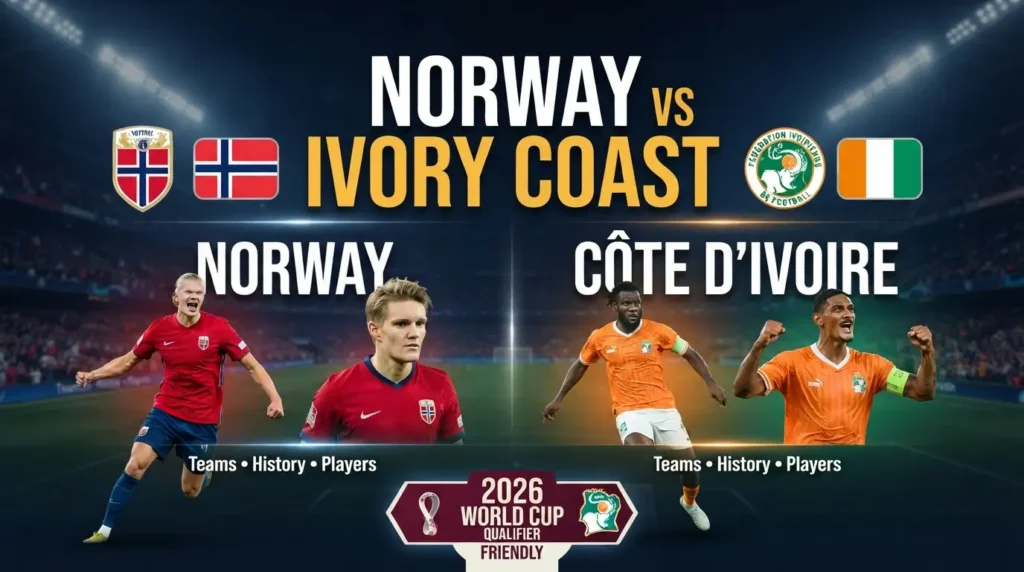
The Norway vs Ivory Coast matchup became an interesting part of the 2026 FIFA World Cup after the two national teams met in the knockout stage. Norway entered the tournament with a renewed sense of confidence after returning to the World Cup for the first time in 28 years, while Ivory Coast arrived with a talented squad and strong performances from the group stage.
Although Norway and Ivory Coast come from very different football traditions, both teams have produced outstanding players and have competed successfully at international level. Norway has become known for its modern attacking football and world-class goalscorer Erling Haaland, while Ivory Coast has a long history of producing powerful, technical players who have succeeded at major European clubs.
The meeting between the two sides on June 30, 2026, gave fans a chance to see these different football styles in the same match. Norway eventually won 2–1, with goals from Antonio Nusa and Erling Haaland, while Amad Diallo scored for Ivory Coast.
Norway vs Ivory Coast: Quick Overview
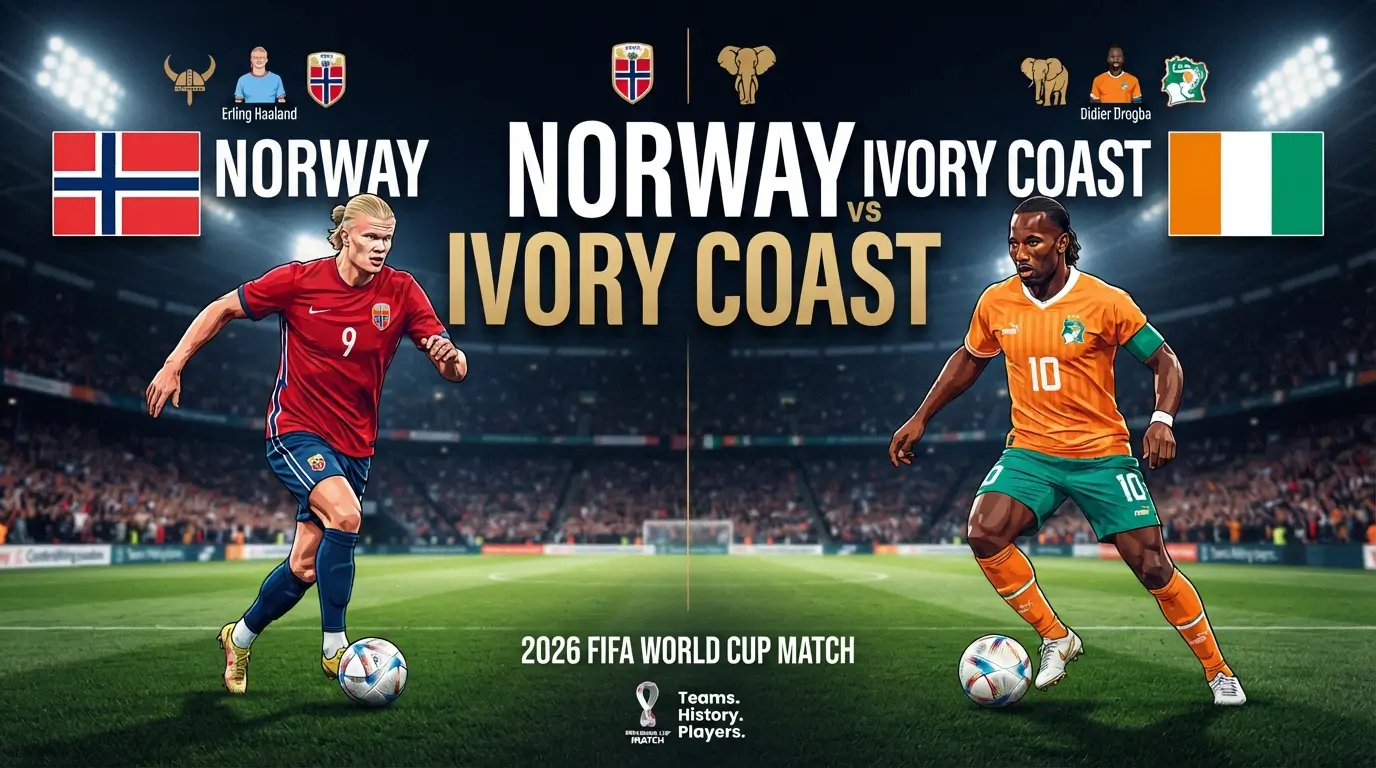
Norway represents European football through the Norwegian Football Federation, while Ivory Coast represents West African football through the Fédération Ivoirienne de Football.
The two countries have not frequently met at senior men’s international level. According to available head-to-head records, their 2026 World Cup game was the first recorded meeting between the teams in the available database. Norway’s victory gave it a 1–0 record against Ivory Coast, with two goals scored and one conceded.
That makes the matchup particularly interesting because there is very little historical head-to-head data compared with rivalries involving teams that regularly meet in international competitions.
Norway’s Football History
Norway has a proud football tradition, although the men’s national team has spent long periods outside the biggest international tournaments.
Before 2026, Norway’s last FIFA World Cup appearance had been in 1998. The team’s return in 2026 ended a 28-year absence from the tournament. FIFA reported that Norway qualified with a perfect qualifying campaign, with Haaland scoring 16 goals during qualification.
That qualifying performance created considerable attention around the team. Norway had a talented core that included Erling Haaland and Martin Ødegaard, giving the side both a world-class striker and a creative midfielder capable of controlling important moments.
Norway’s football identity has also changed over the years. The team has traditionally been associated with physical football and direct attacking play, but the modern side has shown greater emphasis on possession, passing, movement, and technical quality.
Ivory Coast’s Football Tradition
Ivory Coast is one of Africa’s most respected football nations.
The country has produced generations of talented players who have played at some of Europe’s biggest clubs. Didier Drogba is perhaps the most internationally recognized example, but the country has also produced many other elite players across midfield, defense, and attack.
Ivory Coast’s national team has regularly competed in the Africa Cup of Nations and World Cup competitions. The team is known for its athletic ability, technical skill, and attacking options.
The 2026 World Cup squad represented another generation of Ivorian talent. Players such as Amad Diallo brought creativity and speed to the attack, while the team’s physical strength made it difficult for opponents to control the match.
Norway vs Ivory Coast at the 2026 World Cup
The Norway vs Ivory Coast match took place on June 30, 2026, in the Round of 32 at AT&T Stadium in Texas.
Norway won the match 2–1.
Antonio Nusa opened the scoring for Norway in the 39th minute. Ivory Coast continued to compete and eventually found an equalizer through Amad Diallo in the 74th minute.
The game appeared to be heading toward extra time, but Norway found a late winner.
Erling Haaland scored in the 86th minute to give Norway a 2–1 advantage. The goal proved decisive and sent Norway into the next round.
For Norway, the victory had additional historical importance. Reuters reported that it was the country’s first-ever World Cup knockout-stage victory.
Match Statistics
The statistics from the game show how closely contested the match was.
Norway had 53 percent possession compared with 47 percent for Ivory Coast. Norway also completed more accurate passes, with 415 compared with 339 for Ivory Coast.
However, Ivory Coast created several opportunities and actually recorded more total shots. The Ivorians had 14 shots, including five on target, while Norway recorded nine shots with four on target.
Ivory Coast also earned 14 corners compared with three for Norway. This suggests that the African side created considerable pressure from wide areas and set-piece situations.
Norway, however, was more efficient at key moments. Two of its four shots on target resulted in goals.
That difference between possession, chances, and finishing made the match particularly interesting.
Erling Haaland’s Role for Norway
It is difficult to discuss modern Norway without mentioning Erling Haaland.
The Manchester City striker has become one of the most recognizable goalscorers in world football. His combination of height, strength, speed, positioning, and finishing makes him a constant threat inside the penalty area.
Haaland entered the 2026 World Cup after an impressive qualifying campaign. FIFA reported that he scored 16 goals during Norway’s successful qualification campaign.
Against Ivory Coast, however, he did not have an easy evening.
The Ivorian defense limited his opportunities for much of the match. Reuters reported that Haaland struggled to receive regular service and became increasingly isolated during parts of the game.
Yet this is exactly why elite strikers can be so important. Haaland did not need many opportunities to change the result.
His late goal gave Norway the lead again and ultimately decided the match.
Antonio Nusa and Norway’s Attack
Antonio Nusa was another important player in the Norway vs Ivory Coast match.
Nusa scored Norway’s opening goal in the 39th minute. His pace and ability to attack defenders gave Norway another dimension beyond Haaland.
Having multiple attacking threats is important for a national team because opponents can sometimes focus heavily on one superstar.
If defenders concentrate too much on Haaland, other Norwegian attackers can find space. If they move away from the Norwegian striker, Haaland can become dangerous.
This balance was visible during the match against Ivory Coast.
Amad Diallo’s Impact
For Ivory Coast, Amad Diallo provided one of the game’s most important moments.
He scored the equalizer in the 74th minute, bringing Ivory Coast back into the match after Norway had taken the lead.
Diallo’s technical ability and dribbling made him an important attacking player. The statistics also showed Ivory Coast’s strength in one-on-one situations. The team attempted 20 dribbles and completed seven, compared with 18 attempts and three successful dribbles for Norway.
His goal demonstrated Ivory Coast’s ability to respond under pressure.
Unfortunately for the Ivorian side, the equalizer did not lead to extra time because Norway found another goal late in the match.
Tactical Differences Between the Teams
One of the most interesting aspects of Norway vs Ivory Coast is the contrast between their football styles.
Norway used its passing ability to control significant periods of possession. The team completed passes at an accuracy of 87.6 percent, compared with 84.5 percent for Ivory Coast.
Ivory Coast, meanwhile, showed a strong attacking presence through crosses, dribbling, and set-piece pressure.
The Ivorian side attempted 29 crosses compared with 10 from Norway. This indicates a greater willingness to attack from wide areas and deliver the ball into dangerous positions.
Norway’s aerial strength was also useful. The team won 16 aerial duels compared with 12 for Ivory Coast.
These differences created an entertaining tactical battle.
Norway’s Road to the 2026 World Cup
Norway’s qualification for the 2026 tournament was one of the biggest stories surrounding the team.
The country had waited 28 years to return to the World Cup. FIFA noted that Norway completed a perfect qualifying campaign and that Haaland played a major role in that achievement.
The tournament itself then provided another historic moment.
After defeating Ivory Coast 2–1, Norway moved forward to face Brazil in the next round.
For Norwegian supporters, simply returning to the World Cup was already significant. Advancing through a knockout match made the campaign even more memorable.
Ivory Coast’s World Cup Campaign
Ivory Coast also produced some strong results during the 2026 tournament.
Before facing Norway, the team had won its group-stage match against Ecuador 1–0, lost 2–1 to Germany, and defeated Curaçao 2–0.
That record showed the competitive nature of the team.
Ivory Coast entered the knockout stage with confidence and then pushed Norway to the final minutes. The 2–1 defeat was narrow, with the winning goal arriving only four minutes before the end of normal time.
The result therefore does not tell the entire story of how competitive the match was.
FIFA Rankings and Team Development
FIFA’s July 20, 2026 rankings placed Norway 19th in the men’s world ranking and Ivory Coast 31st.
These rankings provide useful context when looking at the two teams, although rankings change over time as national teams play more matches.
Norway’s ranking had improved considerably compared with its position in previous years. FIFA’s historical data shows Norway ranked 29th at the end of 2025 and 43rd at the end of 2024.
Ivory Coast also improved compared with earlier years, moving from 42nd at the end of 2025 to 31st in the July 2026 ranking.
These changes reflect the competitive progress of both national teams.
Norway vs Ivory Coast Head-to-Head Record
The available head-to-head record is very small.
The 2026 World Cup match is recorded as a 2–1 victory for Norway, giving Norway one win and Ivory Coast no wins in the available meetings.
Because the teams have rarely met, it would be misleading to describe Norway vs Ivory Coast as a traditional international rivalry.
Instead, the matchup is better understood as a meeting between two teams from different football regions that produced an important World Cup knockout game.
What Makes Norway vs Ivory Coast Interesting?
The matchup is interesting because of the contrast between the teams and their football backgrounds.
Norway has entered a new era built around young, internationally recognized stars. Haaland provides extraordinary finishing ability, while Ødegaard gives the team creativity and leadership.
Ivory Coast has a different football tradition. Its national team has long been known for producing technically gifted and physically strong players who compete at the highest level of European football.
The 2026 World Cup meeting brought these qualities together in one match.
The statistics showed a balanced contest, while the final result was decided by Norway’s ability to find a late goal.
Final Thoughts
The Norway vs Ivory Coast matchup at the 2026 FIFA World Cup will be remembered as an important moment for both teams.
For Norway, the 2–1 victory represented the country’s first-ever World Cup knockout-stage win and continued the positive momentum created by its return to the tournament after 28 years.
For Ivory Coast, the match showed that the team could compete strongly against a highly rated European side. The Ivorians created more shots and corners, scored an equalizer, and remained in contention until the closing stages.
Ultimately, Haaland’s late goal separated the teams.
The result also demonstrated why international football can be so unpredictable. Statistics such as possession and shots can explain parts of a match, but a single moment of finishing quality can decide everything.
As both nations continue developing their next generations of players, future meetings could provide another chapter in the growing history of Norway vs Ivory Coast football.



[…] Jordan’s progress demonstrates that a country does not need decades of World Cup success to build a competitive national team. […]