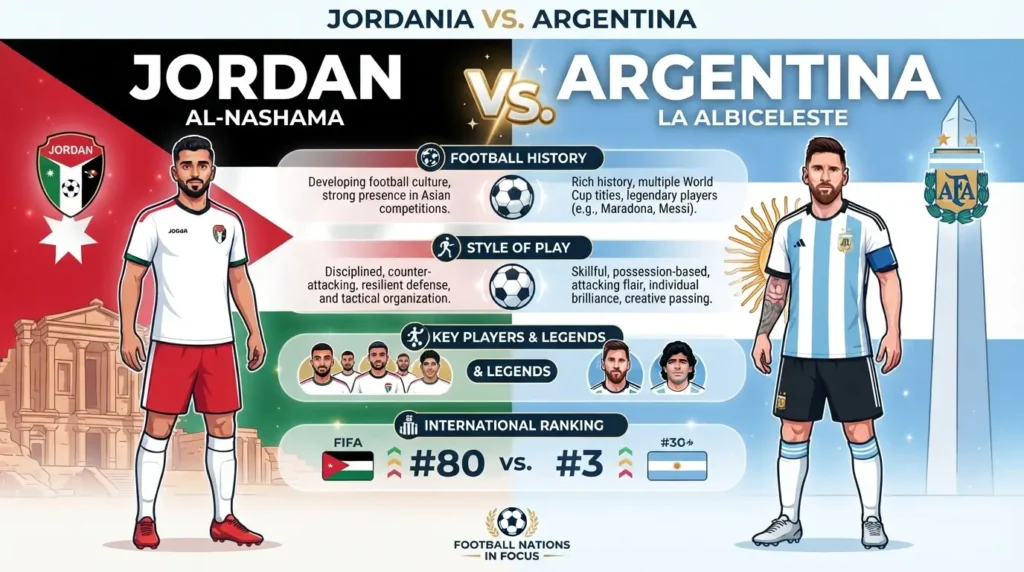
Jordania vs. Argentina is an interesting football comparison because the two national teams come from very different football traditions. Jordan, officially known as the Hashemite Kingdom of Jordan, has built a strong football culture in Asia and has become increasingly competitive in the Middle East. Argentina, meanwhile, is one of the most famous football nations in the world, with a long history of international success and some of the greatest players the sport has ever produced.
When people search for Jordania vs. Argentina, they may be looking for information about a particular match, the difference between the two teams, their playing styles, or their international records. Whatever the reason, the comparison provides an interesting look at how football has developed in two very different regions.
Argentina is traditionally associated with technical football, creative attacking players, and a strong competitive mentality. Jordan has developed its own identity based on organization, teamwork, discipline, and an increasingly ambitious approach to international competition.
This article looks at the football history of both countries, their playing styles, important players, international achievements, and what makes a meeting between them interesting for fans.
Jordania vs. Argentina: A Look at the Two Teams

The first thing to understand is that Jordan and Argentina operate in very different football environments.
Jordan competes in the Asian Football Confederation, while Argentina competes in the South American Football Confederation. South American football is widely known for its highly competitive national-team environment, where Argentina regularly faces teams such as Brazil, Uruguay, Colombia, Chile, and Ecuador.
Jordan’s football journey takes place in a different environment. The country competes against strong Asian teams including Japan, South Korea, Iran, Saudi Arabia, Qatar, Australia, and Iraq.
Both environments are challenging, but the styles and football cultures can be quite different.
Argentina has historically produced a huge number of world-class players. Jordan has not had the same global player-production system, but the national team has made important progress and has established itself as a respected side in Asian football.
Argentina’s Football Tradition
Argentina has one of the richest football histories in the world.
The country has won the FIFA World Cup three times, with its most recent triumph coming in 2022. Argentina also won the tournament in 1978 and 1986.
The 1986 team is remembered largely because of Diego Maradona, one of football’s most influential players. Decades later, Lionel Messi became the central figure of another historic generation and helped Argentina win the 2022 World Cup.
Argentina’s success is not based only on individual stars. The country has a deep football culture that develops players from a young age.
Football is deeply connected to everyday life in Argentina. Young players commonly grow up playing the sport in local clubs, academies, schools, and neighborhood competitions.
This environment has helped Argentina consistently produce technically gifted footballers.
Jordan’s Football Development
Jordan has a much smaller football history on the global stage, but the national team has made significant progress in recent years.
The Jordan national team is known as the Al-Nashama, a name associated with determination and courage. The team has become increasingly competitive in Asian football and has attracted greater international attention through strong performances in major tournaments.
One of the most important moments in Jordan’s recent football history came at the AFC Asian Cup, where the team reached the final in 2023, played in January and February 2024.
Jordan’s run to the final was a major achievement. The team defeated strong opponents along the way and demonstrated that it could compete with some of Asia’s best national sides.
Although Jordan did not win the tournament, reaching the final represented a major step forward for the country’s football program.
Different Football Cultures
One of the most interesting parts of Jordania vs. Argentina is the contrast between their football cultures.
Argentina has produced legendary footballers for generations. Names such as Maradona, Messi, Gabriel Batistuta, Juan Román Riquelme, Javier Zanetti, and many others are part of the country’s football history.
Jordan has developed fewer internationally famous players, but its football culture continues to grow.
The difference does not mean that one country’s football culture is more important than the other. Instead, it shows how national teams develop according to their history, resources, football systems, and regional competition.
Jordan’s progress demonstrates that a country does not need decades of World Cup success to build a competitive national team.
Playing Style of Argentina
Argentina is traditionally associated with technical football.
The national team has often relied on players who are comfortable controlling the ball in tight spaces. Creativity, passing, movement, and intelligent positioning have been important parts of Argentine football.
However, modern Argentina is not simply an attacking team that depends on individual skill.
The national team has also developed a strong defensive structure. The balance between attacking creativity and defensive organization has been one of the important features of Argentina’s recent success.
Players are expected to work for the team, press opponents when appropriate, and maintain their shape without the ball.
This combination makes Argentina difficult to play against.
Playing Style of Jordan
Jordan’s national team has developed a reputation for being organized and difficult to break down.
The team can be dangerous in transition, particularly when it wins possession and quickly moves forward.
Jordan has also shown that it can compete through teamwork rather than relying on one superstar.
During its successful Asian Cup campaign, the team demonstrated strong defensive organization and effective attacking transitions.
Set pieces can also be important in matches involving Jordan. Corners and free kicks provide opportunities to create chances against teams that may otherwise dominate possession.
Important Players From Argentina
Argentina’s football history contains an extraordinary number of famous players.
Lionel Messi
Lionel Messi is arguably the most recognizable Argentine footballer of the modern era.
He spent much of his club career at Barcelona before later playing for Paris Saint-Germain and Inter Miami. For Argentina, his career included Copa América success and the 2022 World Cup triumph.
Messi’s influence goes beyond goals and assists. His ability to create chances, control games, and attract defenders has made him one of the defining players of his generation.
Diego Maradona
Diego Maradona remains one of the most important figures in Argentine football history.
His performances during the 1986 World Cup helped Argentina win the tournament, and his creativity and technical ability made him an international icon.
Ángel Di María
Ángel Di María has also played an important role in Argentina’s modern era.
Known for his pace, movement, crossing, and finishing, Di María has scored important goals for Argentina in major competitions.
His experience has been especially valuable during the team’s successful recent period.
Important Jordan Players
Jordan may not have the same global collection of stars as Argentina, but the country has produced several important international players.
Mousa Al-Taamari
Mousa Al-Taamari is one of Jordan’s best-known modern footballers.
His speed, technical ability, and attacking movement have made him an important player for the national team.
He has also gained experience playing European club football, which has helped increase his international profile.
Yazan Al-Naimat
Yazan Al-Naimat has also become an important attacking player for Jordan.
His movement and finishing ability have made him a significant part of Jordan’s attacking approach.
Players like Al-Taamari and Al-Naimat represent the increasing quality of Jordan’s football generation.
Jordania vs. Argentina: Strengths of Each Team
When comparing the two teams, their strengths are quite different.
Argentina’s major strengths include technical quality, international experience, tactical flexibility, and a deep pool of talented players.
Jordan’s strengths include organization, team discipline, physical commitment, quick transitions, and confidence developed through strong performances in Asian competition.
Argentina can often control games through possession and technical quality. Jordan can be especially dangerous when opponents leave space behind their defensive line.
That contrast would make a competitive meeting between the two teams tactically interesting.
What Would Make a Match Between Them Interesting?
A Jordania vs. Argentina match would bring together two very different football approaches.
Argentina would likely have the technical resources to control large periods of the match, while Jordan would have opportunities to create problems through defensive organization and counterattacking football.
The midfield battle would be especially important.
If Argentina controlled possession and prevented Jordan from launching quick attacks, it could reduce Jordan’s opportunities.
On the other hand, if Jordan defended effectively and created turnovers in midfield, the team could use speed to attack open spaces.
Set pieces could also play an important role.
The Importance of International Experience
Experience is another major difference between the teams.
Argentina regularly competes in the Copa América and FIFA World Cup, tournaments that expose players to extremely high levels of international football.
Jordan’s main competitive environment is Asian football, including the AFC Asian Cup and World Cup qualification.
Jordan’s recent performances have shown that the team can compete at a high level in Asia, but Argentina’s history of facing elite international opposition gives it a much broader experience base.
That experience can become particularly valuable during high-pressure matches.
Jordan’s Rise in Asian Football
The growth of Jordanian football is worth watching.
Reaching the AFC Asian Cup final showed that Jordan can challenge established Asian football powers.
The team’s progress has also increased interest in Jordanian players and the country’s domestic football system.
Young Jordanian players now have a stronger example of what the national team can achieve. Success at international level can inspire investment in youth development, coaching, facilities, and professional opportunities.
This is how national football programs can gradually improve.
Argentina’s Continued Evolution
Argentina’s football story is not only about its historic achievements.
The national team has continued to evolve as different generations replace older players.
After the era of Maradona came several other strong generations, and the modern era has been strongly associated with Messi and the players around him.
The challenge for Argentina is always to maintain its high standards when experienced stars retire.
Young players entering the national team system will be expected to continue a tradition that includes World Cup titles, Copa América victories, and generations of legendary footballers.
Why Fans Should Follow Jordan
Jordan is an interesting team for football fans because its development shows how international football is changing.
National teams outside the traditional global powers can improve rapidly when they develop strong youth systems, professional coaching, and a clear tactical identity.
Jordan’s recent Asian Cup success demonstrated that the team should not be treated as an easy opponent.
Its rise also adds more variety to Asian international football.
Why Argentina Remains a Major Football Nation
Argentina’s place in world football is based on much more than its famous players.
The country has an established football culture, strong club competition, youth development, tactical knowledge, and a long history of international success.
The three World Cup titles are one part of that story.
Its influence can also be seen in the number of Argentine players who have played important roles at major European clubs.
Final Thoughts
The Jordania vs. Argentina comparison highlights two different football journeys.
Argentina represents one of the world’s strongest football traditions, with three World Cup championships and generations of legendary players. Jordan represents a developing football nation that has made impressive progress and reached the final of the AFC Asian Cup.
The two teams differ in history, resources, international experience, and football culture, but both have qualities that make them interesting to watch.
Argentina brings technical quality, creativity, tactical experience, and a deep tradition of success. Jordan brings organization, determination, teamwork, and the confidence that comes from its recent rise in Asian football.
If these teams meet in an official or friendly international match, the contrast in styles would be one of the most interesting parts of the game. Argentina’s ability to control possession and create chances would be tested against Jordan’s defensive structure and ability to attack quickly.
For football fans, that is what makes international football special. Different countries develop different identities, and a match between two teams from very different football backgrounds can provide a fascinating tactical and cultural story.